
TL;DR: Application dependency mapping (ADM) platforms map how apps, services, and infrastructure connect. Best for: Faddom (agentless mapping), Device42 (CMDB-based discovery), Dynatrace (full-stack observability), and ServiceNow ITOM (ITSM-integrated service mapping).
What Are Application Dependency Mapping Platforms?
Application dependency mapping (ADM) platforms automatically identify and visualize the relationships between applications, services, and infrastructure components. These tools help organizations understand how applications interact, detect dependencies, and track changes in real time.
ADM platforms are crucial for IT operations, cloud migrations, security audits, and incident response. They provide insights into system architecture, helping teams optimize performance, troubleshoot issues, and ensure compliance. By continuously monitoring dependencies, ADM platforms reduce risks associated with configuration changes and service disruptions.
Application Dependency Mapping Platforms At a Glance
The table below summarizes the key differences between these application dependency mapping platforms. We explore each tool in more detail in the sections that follow.
|
Category |
Solution |
Best For |
Key Strengths |
Things to Consider |
|
Agentless Dependency Mapping |
Faddom |
Agentless real-time mapping without agents or credentials |
Fast initial deployment, continuous 24/7 updates, migration wave planning |
Learning curve with terminology; limited granularity for some cloud-native resources |
|
Agentless Dependency Mapping |
Device42 |
Hybrid IT discovery with a built-in CMDB |
Broad discovery methods (WMI, SSH, SNMP), Visio-compatible diagrams, migration move groups |
Setup complexity; some capabilities priced as add-ons |
|
Agentless Dependency Mapping |
BMC Helix Discovery |
Enterprise service modeling feeding observability and AIOps |
Blueprint-based service modeling, data reconciliation, security and compliance detection |
High licensing cost; appliance storage capped at 2TB |
|
Observability and Cloud Migration |
Dynatrace Topology Discovery and Application Mapping |
Full-stack observability with automated topology mapping |
Single-agent discovery, Smartscape visualization, AI-driven root-cause analysis |
High cost; steep learning curve |
|
Observability and Cloud Migration |
ServiceNow IT Operations Management (ITOM) |
End-to-end service mapping tied to ITSM workflows |
Dynamic CMDB-based discovery, AIOps event correlation, change impact analysis |
Complex setup; value depends on CMDB maturity |
|
Observability and Cloud Migration |
AWS Transform |
Migrating VMware workloads specifically to AWS |
Automated discovery and wave planning, network conversion to IaC, guided migration execution |
Requires a 24-month AWS usage commitment; AWS-only destination |
Key Features of ADM Platforms
Application dependency mapping platforms typically include the following capabilities.
Automated Discovery
ADM platforms use various methods—agent-based, agentless, or hybrid—to scan IT environments and detect application dependencies. Agent-based discovery involves installing lightweight software on servers to gather real-time data, while agentless discovery connects through APIs, network protocols, or log analysis to identify relationships without installing software.
These tools detect infrastructure components such as servers, databases, virtual machines, microservices, and cloud instances. They map how these components interact, helping organizations understand their architecture without relying on manual documentation. This reduces errors, accelerates IT audits, and improves visibility into shadow IT—unauthorized systems that could pose security risks.
Real-Time Visualization
ADM platforms generate interactive maps that dynamically update as changes occur. These visualizations illustrate dependencies across applications, databases, and services, helping teams understand the impact of failures or modifications.
Real-time visualization enables IT teams to:
- Quickly diagnose incidents by identifying affected services and their dependencies.
- Detect redundant or underutilized resources, optimizing costs and performance.
- Improve cloud migration planning by mapping application architectures before, during, and after the transition.
Change Tracking
ADM platforms continuously monitor applications and infrastructure for changes, logging modifications in real time. Every update—whether a software deployment, configuration change, or new service connection—is recorded to provide historical context for troubleshooting and compliance audits.
With change tracking, organizations can:
- Identify unauthorized modifications that may lead to security vulnerabilities.
- Analyze performance trends by correlating changes with system behavior.
- Prevent outages by detecting risky changes before they cause failures.
Some platforms offer automated alerts for critical changes, ensuring that IT teams can respond quickly to unintended modifications. Integration with IT service management (ITSM) tools further improves visibility into the change management process.
Performance Monitoring
ADM platforms improve IT performance by identifying dependencies that contribute to slow response times, network congestion, or resource contention. By continuously monitoring application interactions, these tools help detect performance bottlenecks before they impact end users.
Key performance monitoring capabilities include:
- Latency analysis to identify slow inter-service communications.
- Resource utilization tracking for optimizing CPU, memory, and storage usage.
- Dependency-based alerting that notifies teams when performance thresholds are exceeded.
Security and Compliance
ADM platforms strengthen security by identifying unauthorized or vulnerable dependencies. They detect misconfigurations, unencrypted connections, and unapproved third-party integrations that could expose an organization to risks.
For compliance, these platforms:
- Ensure data flow transparency, helping organizations meet regulations like GDPR, HIPAA, and PCI DSS.
- Monitor access permissions, detecting unauthorized changes that could lead to data breaches.
- Support forensic investigations by providing detailed dependency change logs.
Use Cases of ADM Platforms
Incident Management and Troubleshooting
ADM platforms simplify incident response by providing real-time visibility into application dependencies. When an issue arises, IT teams can quickly identify which services, databases, or infrastructure components are affected. This reduces mean time to resolution (MTTR) by enabling faster root cause analysis.
Key benefits include:
- Dependency-aware alerting, helping teams prioritize critical issues.
- Impact analysis, showing how failures propagate across the system.
- Historical change tracking, allowing teams to pinpoint configuration changes that led to incidents.
Cloud Migration and Optimization
ADM platforms help organizations map existing application dependencies before migrating workloads to the cloud. This prevents common migration issues such as broken service links, misconfigured networking, and unexpected latency.
Use cases include:
- Pre-migration assessment, identifying applications that rely on on-premises infrastructure.
- Migration validation, ensuring dependencies remain intact post-migration.
- Cost and performance optimization, detecting underutilized resources for rightsizing.
By providing a clear blueprint of application interactions, ADM platforms enable smoother cloud transitions and ongoing performance improvements in multi-cloud or hybrid environments.
DevOps and CI/CD Pipelines
ADM platforms support DevOps teams by improving visibility into service dependencies within continuous integration and deployment (CI/CD) workflows. They help prevent deployment failures caused by overlooked dependencies or misconfigured integrations.
Key advantages include:
- Automated dependency validation before code deployments.
- Rollback support, allowing teams to revert changes if performance degrades.
- Microservices monitoring, ensuring seamless interactions between containerized applications.
Security Auditing and Risk Assessment
ADM platforms strengthen security by identifying unprotected dependencies, unauthorized services, and potential attack paths. They provide real-time monitoring of security-related changes, helping organizations enforce policies and comply with regulations.
Security-related benefits include:
- Unauthorized service detection, identifying shadow IT or unapproved third-party integrations.
- Access control verification, ensuring that only authorized systems communicate.
- Regulatory compliance support, with automated audits for frameworks like GDPR, HIPAA, and NIST.
6 Leading Application Dependency Mapping Platforms
Agentless Dependency Mapping Platforms
1. Faddom


Faddom is an agentless application dependency mapping platform that discovers and maps infrastructure, business applications, and their dependencies across on-premises and cloud environments. It uses AI-driven correlation and analysis to turn raw network data into real-time application and dependency maps. The platform deploys without agents, credentials, or firewall changes, runs in read-only mode, and can operate offline so that collected data stays within the environment. After deployment, it produces a first map within about 60 minutes and automatically groups discovered servers into business applications. The map updates continuously, around the clock, as the environment changes, and the platform is built to work across hybrid and multi-cloud setups regardless of the underlying technology.
Key features include:
- Agentless real-time mapping: Faddom maps on-premises and cloud infrastructure by analyzing network traffic rather than installing agents. It requires no server credentials or firewall changes, runs read-only, and can operate offline, so all data remains inside the environment being mapped.
- Automatic application grouping: The platform automatically groups discovered servers into business applications and visualizes east-west and north-south traffic. It produces an initial set of maps within roughly an hour of deployment, removing the need for manual diagramming.
- Change tracking and impact analysis: Faddom continuously updates the map 24/7 and tracks changes as they happen. It is used to review the upstream and downstream impact of a planned change before it is made, supporting change management and reducing the risk of unplanned outages.
- Migration planning: The platform supports data center and cloud migration by mapping dependencies before and after a move and organizing work into wave-based plans. This helps teams identify which servers and applications must move together.
- Security and compliance: Faddom identifies shadow IT, unknown or external connections, and expiring SSL/TLS certificates, and flags software weaknesses such as outdated components. It maintains continuously updated documentation that can be used for IT audits, compliance, and internal attack surface management.
- Integrations and documentation: The platform maintains an always-current source of truth for IT documentation and integrates with ITSM and security tooling, including Jira Service Management and ServiceNow CMDB, so dependency data can feed existing workflows.
Limitations (as reported by users on G2):
- Initial learning curve: Some users note that the platform’s terminology and the breadth of its features take time to learn, and that getting fully up to speed can benefit from working with the support team during onboarding.
- Reporting and map presentation: A few users would like richer exportable reports and clearer dependency-map layouts when working with very large or complex environments.
- Granularity in certain scenarios: Because discovery is agentless and based on network traffic, some users mention that specific cases—such as load balancers, certain cloud-native or serverless resources, or heavily encrypted traffic—may require additional configuration.
2. Device42


Device42, now part of Freshworks, is an agentless discovery and dependency mapping platform for hybrid IT environments. It automatically discovers hardware, software, and application dependencies and builds a centralized map of the relationships between them across data centers and cloud. Discovery is performed using native Windows (WMI) and Linux (SSH) protocols and SNMP for network hardware, and the platform can map dependencies for machines that cannot be directly accessed by using Netflow data. Device42 maintains a built-in, continuously updated CMDB that serves as a single source of truth. It is used for migration planning, change control, asset management, and incident resolution.
Key features include:
- Agentless auto-discovery: Device42 discovers deployed applications, their dependencies, manufacturers, and versions, along with service dependencies, protocols, and ports. It uses WMI, SSH, and SNMP, and can build maps for inaccessible machines from Netflow data.
- Application dependency mapping and diagrams: The platform generates dependency maps, charts, lists, and flow diagrams that show application-to-application and application-to-server relationships. Diagrams are Visio-compatible and highlight the impact of an application for migration or change control.
- Built-in CMDB: Device42 includes a near real-time, automated CMDB that can also auto-populate CMDBs in other ITSM tools. It is positioned as a single source of truth for hybrid IT inventory.
- Cloud and full-stack discovery: The platform performs cloud discovery for AWS and Azure and full-stack discovery spanning legacy systems such as mainframes through to containers, along with storage discovery across multiple storage vendors.
- Migration support and move groups: Device42 builds affinity-based move groups for migrations and includes a cloud recommendation engine for instance sizing. Data can be exported to Excel, CSV, or an external database, and flexible APIs (including its DOQL query language) allow integration with other products.
- Additional management modules: The platform bundles related capabilities including IP address management (IPAM), SSL certificate discovery and management, software license management, and password management.
Limitations (as reported by users on G2):
- Setup complexity and learning curve: Users report that the platform can feel complex to set up and navigate at first, particularly for smaller teams, and that it takes time to understand fully.
- Performance with large data volumes: Some users note slowdowns or latency when handling large data sets or high request volumes against the single appliance.
- Pricing structure: Several users mention that some capabilities are priced as separate add-ons rather than included, which can raise costs for smaller organizations.
- Dependency mapping refinements: A few users note that application dependency data is not always real-time and that topology diagrams and the ability to bulk-export diagrams or reports could be improved.
- Interface: Some users describe the user interface as dated, with limited dashboard customization options.
3. BMC Helix Discovery


Source: BMC
BMC Helix Discovery is an agentless discovery and dependency modeling solution that maps IT assets and service dependencies from cloud to on-premises. It is available for deployment as SaaS or on-premises and continuously discovers assets and their relationships without requiring manual updates. The product feeds its topology data, along with third-party data, into the broader BMC Helix platform to support observability and AIOps. It is used for security and compliance, service awareness, enterprise asset management, and multi-cloud visibility across data centers, clouds, and containers.
Key features include:
- Agentless continuous discovery: BMC Helix Discovery automatically discovers assets and maps relationships across cloud and on-premises environments, keeping the data current without manual updates.
- Blueprint-automated service modeling: The product uses a library of service modeling blueprints to map infrastructure to the specific business services it supports, helping teams visualize and control that infrastructure.
- Data reconciliation: It unifies topology data from multiple sources into a single, consistent view, reducing duplicate or conflicting records across environments.
- Real-time service awareness: The platform connects service models, topology, and telemetry to identify root causes and visualize related impacts, and merges real-time data with historical performance trends to support proactive outage alerting and recommendations.
- Security and compliance: Detailed asset data is used to pinpoint risks and locate backdoor entry points, and automated asset inventories support regulatory compliance. Blind spot detection exposes hidden or undocumented assets and relationships, and the product can discover and manage SSL/TLS certificates.
Limitations (as reported by users on G2):
- Cost: Users frequently cite high licensing costs and add-on pricing for updates, noting it can be more expensive than some competing tools.
- Storage limits: Several users mention that the appliance does not support a system disk larger than 2TB, which can constrain organizations handling large data sets.
- Interface usability: Some users find the graphical interface less intuitive and harder for beginners to learn.
- Integration and support: Users note that integration with non-BMC tools and support responsiveness for newer software could be improved, and that upgrades may require pausing production access.
- Cloud migration assessment: Some users note that it lacks the dedicated cloud migration assessment features that certain competitors provide
Observability and Cloud Migration Platforms
4. Dynatrace Topology Discovery and Application Mapping


Source: Dynatrace

Dynatrace Topology Discovery and Application Mapping automatically discovers the components and dependencies of an entire technology stack and visualizes them. Using a single agent and its Smartscape technology, Dynatrace detects causal dependencies between applications, services, processes, hosts, networks, and infrastructure, typically within minutes and without manual configuration. It covers a broad range of technologies, including AWS, Azure, Google Cloud, Kubernetes, Docker, Java, .NET, databases, SAP, VMware, Windows, and Linux. Beyond mapping, Dynatrace learns the environment’s normal performance and applies AI to detect anomalies and perform root-cause analysis. Dependency mapping is one capability within the broader Dynatrace observability platform.
Key features include:
- Single-agent auto-discovery: After installing one agent, Dynatrace discovers all components and dependencies of the technology stack end-to-end in minutes, with no manual configuration required.
- Smartscape topology visualization: Smartscape detects causal dependencies between websites, applications, services, processes, hosts, networks, and infrastructure and displays the full topology in an interactive, dynamically updated map.
- Broad technology coverage: The platform supports a wide range of technologies, including major cloud providers, Kubernetes and Docker, common languages and runtimes, databases, SAP, VMware, and mainframe environments.
- Self-learning baselines and anomaly detection: Dynatrace automatically learns the environment’s normal performance and identifies anomalies without manual threshold tuning, and its AI determines whether a problem affects customers.
- Automated root-cause analysis: The platform uses AI and big-data analytics to pinpoint the cause of performance problems and continuously recognizes changes to the environment, maintaining an up-to-date blueprint of the application architecture.
Limitations (as reported by users on G2):
- Cost: Users of the broader Dynatrace platform describe it as one of the more expensive options on the market, and note that costs can rise if the platform is not configured carefully.
- Learning curve: Many users report a steep learning curve and the need for training to use the platform effectively.
- Complexity: Some users find the breadth of features and the interface overwhelming, particularly for new users, and note that advanced capabilities require additional configuration.
5. ServiceNow ITOM


Source: ServiceNow

ServiceNow IT Operations Management (ITOM) provides visibility into infrastructure and services across on-premises, hybrid, and cloud environments. It federates signals from systems, services, and applications, automatically discovers IT resources, and builds dynamic service maps using the Common Services Data Model (CSDM). ITOM runs on the ServiceNow platform and integrates natively with ServiceNow ITSM, so operational events detected in the infrastructure can generate and route incidents with root-cause context. It applies AIOps to reduce alert noise, correlate events, and support automated remediation, keeping the CMDB current as the environment changes.
Key features include:
- Dynamic discovery: ITOM automatically discovers and maps end-to-end service dependencies in real time using first- and third-party discovery data, keeping the CMDB accurate and current.
- Service mapping: The product builds dynamic service maps with the Common Services Data Model embedded, providing business context across hybrid and cloud environments in a unified service graph for impact analysis and change management.
- Event intelligence: ITOM correlates and de-duplicates alerts across disparate monitoring tools and applies AIOps to reduce noise, create and prioritize incidents, and accelerate resolution, with Metric Intelligence and anomaly detection.
- Service health and availability: It collects, aggregates, and correlates signals across the landscape, augmenting them with system change data to produce a full-stack view of service health that draws on monitoring, observability, and cloud provider data.
- Change impact analysis and remediation: ITOM shows the downstream impact of a planned change before it is made, and AI agents identify root-cause patterns and trigger orchestrated remediation workflows. It also includes TLS certificate management.
Limitations (as reported by users on G2):
- Setup complexity: Users report that implementation is complex and requires specialized expertise and extensive configuration.
- Steep learning curve: Many users find that the platform takes significant time and training to learn and configure effectively.
- Cost: Users note that licensing and implementation costs are high, which can be challenging for smaller organizations to adopt.
- Dependent on CMDB maturity: Several users note that ITOM’s value depends heavily on a well-maintained CMDB, and that reaching a reliable baseline takes ongoing effort.
- Agent and support issues: Some users report that the Agent Client Collector can be bug-prone and that support response times and product knowledge could be better.
6. AWS Application Discovery Service


Source: Amazon
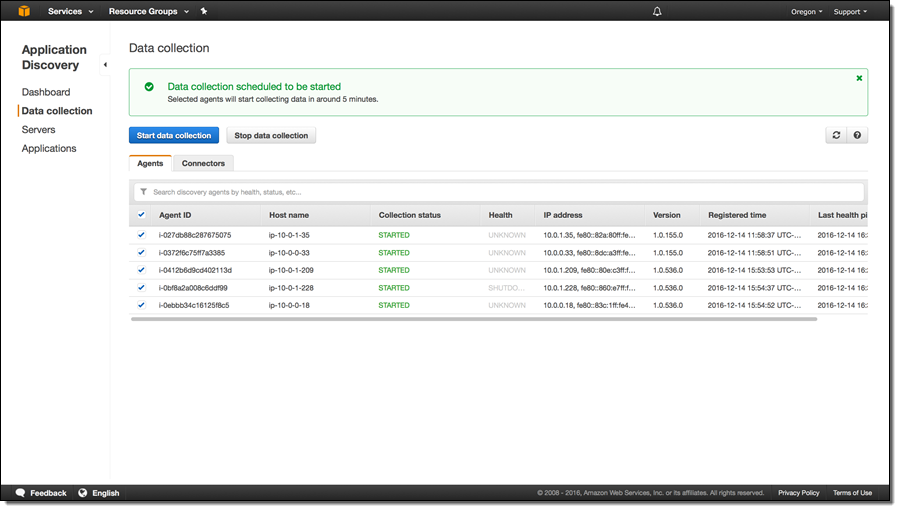
AWS Transform is an agentic AI service for migrating and modernizing VMware workloads to AWS, and it is the service AWS now directs new customers to in place of AWS Application Discovery Service, which closed to new customers in November 2025. AWS Transform automates discovery, dependency mapping, migration wave planning, network conversion, and migration execution. During discovery it collects performance data, network connections, database metadata, and server specifications, and it supports ingestion formats such as RVTools exports. It then analyzes application dependencies, groups workloads into migration waves, generates AWS network configurations, and executes either rehosting to Amazon EC2 or replatforming to containers.
Key features include:
- Automated discovery and assessment: AWS Transform automatically collects detailed environment data—performance metrics, network connections, database metadata, and server specifications—and generates TCO projections and business cases. It supports inputs such as RVTools exports and data from third-party discovery tools.
- Dependency mapping and wave planning: The service analyzes application dependencies and groups workloads into optimized migration waves based on technical and business priorities, accounting for interdependencies, compliance requirements, and business criticality.
- Network conversion: AWS Transform converts on-premises network configurations into AWS equivalents, including VPCs, subnets, security groups, transit gateways, and routing tables, and produces infrastructure-as-code for CloudFormation, CDK, Terraform, and Landing Zone Accelerator formats.
- Landing zone creation: The service generates Landing Zone Accelerator network configurations to establish secure, multi-account AWS environments with governance controls and guardrails before any workload moves.
- Migration execution: AWS Transform rehosts virtual machines by deploying replication agents, launching test instances, tracking progress, and orchestrating cutover, or replatforms applications to Amazon ECS or EKS, with human-in-the-loop validation throughout.
Limitations (based on publicly available sources):
- AWS usage commitment: Under AWS service terms, using AWS Transform requires running the transformed workload on AWS for a minimum of 24 months after the transformation is complete.
- AWS-only target: The service migrates VMware workloads into AWS (Amazon EC2) and is not designed for non-AWS or multi-cloud destinations.
- Job constraints: AWS documentation notes that each migration job targets a single AWS account and Region, and that stopping and then restarting a job causes it to begin again from the start, losing in-progress work.
- Validation required and recently released: AWS notes that customers must review and validate generated network configurations and migration strategies against their own security and compliance requirements, and the service became generally available only in 2025.
Related content: Read our guide to IT mapping
Conclusion
ADM platforms provide critical insights into application dependencies, enabling organizations to improve performance, enhance security, and simplify IT operations. By automating discovery, visualization, and monitoring, they help organizations improve performance, strengthen security, and reduce operational risks. Whether for incident response, cloud migration, or compliance audits, ADM platforms aid in reducing risks and ensuring system reliability.
The right tool can provide real-time visibility, streamline cloud migrations, reduce security risks, and support faster incident response. While all six platforms bring strong capabilities, some offer faster deployment, more flexible discovery methods, and greater cost transparency, making them especially appealing for teams seeking quick time-to-value and minimal setup. As organizations prioritize agility and efficiency, lightweight, agentless solutions are emerging as the preferred approach for modern application dependency mapping.