ITOM Software: Key Features and 8 Notable Solutions in 2026
What Is IT Operations Management (ITOM) Software? ITOM (IT Operations Management) software covers a suite of tools
15 mins
August 9, 2025
Faddom
What Is IT Operations Management (ITOM) Software?
ITOM (IT Operations Management) software covers a suite of tools designed to monitor, manage, and optimize an organization’s IT infrastructure and services. It aims to ensure the smooth, efficient, and reliable operation of IT systems, including networks, servers, applications, and data centers. ITOM software helps organizations achieve this by providing visibility into real-time operations, automating routine tasks, and enabling faster incident response.
Modern ITOM software addresses the complex demands of both on-premises and hybrid cloud environments. It combines multiple capabilities—including asset tracking, event management, and automation—into unified platforms.
Key functions of ITOM software include:
Monitoring: ITOM software continuously monitors various IT components (networks, servers, applications, etc.) to identify performance issues, potential bottlenecks, and security vulnerabilities.
Management: It helps manage the configuration, provisioning, and maintenance of IT resources, ensuring they are properly configured and operating optimally.
Automation: ITOM tools automate routine tasks like patching, resource allocation, and incident response, freeing up IT staff for more strategic initiatives.
Incident response: When issues arise, ITOM software helps teams quickly identify the root cause and resolve incidents, minimizing downtime and business disruption.
Performance management: ITOM tools track key performance indicators (KPIs) and provide insights into the performance of IT services, allowing for proactive optimization.
Service and dependency mapping: ITOM identifies how IT components and services are interconnected and creates visual representations of relationships between them.
Security and compliance management: It provides tools for monitoring configurations, detecting vulnerabilities, and automating compliance checks to maintain audit readiness.
Editor’s note: Updated the article to include recent market data, updated information about ITOM software to reflect features and capabilities in 2026, and added one new tool.
ITOM software offers several key advantages that help organizations maintain efficient, secure, and high-performing IT environments. By centralizing and automating various IT operations, ITOM tools reduce complexity and improve operational effectiveness.
Key benefits include:
Improved efficiency: Automates routine tasks, freeing up IT teams to focus on more strategic initiatives.
Enhanced visibility: Provides real-time insights into system performance, enabling quicker issue detection and resolution.
Reduced downtime: Helps prevent service disruptions by proactively identifying and addressing potential problems before they affect users.
Cost optimization: Simplifies operations and maximizes the use of IT assets, leading to better resource allocation and cost savings.
Faster incident response: Speeds up issue resolution by prioritizing incidents and automating responses, improving mean time to resolution (MTTR).
Better compliance and security: Ensures adherence to security policies and regulatory standards, reducing risks associated with breaches and non-compliance.
Scalability: Supports growing IT environments by automating tasks and processes, reducing the need for additional staff as the infrastructure expands.
Agility: Improves an organization’s ability to respond to changes and innovations in a fast-paced business environment.
According to recent market research, the IT operations management (ITOM) market continues to expand as organizations increase spending on infrastructure monitoring and automation. In 2026, the market is estimated to reach USD 40.67 billion, growing from USD 36.3 billion in 2025. Projections indicate the market could reach USD 71.82 billion by 2031.
Growth is largely driven by the rising complexity of enterprise environments. Organizations now operate across multi-cloud, hybrid infrastructure, edge systems, and 5G networks, which significantly increases the volume of operational data and monitoring requirements. To manage this complexity, companies are investing in platforms that combine predictive analytics, automation, and observability tools.
Major Industry Drivers
One of the primary drivers of ITOM adoption is the rapid expansion of cloud and hybrid infrastructure. Many enterprises now operate across three to five public cloud providers alongside on-premises systems, increasing the number of telemetry streams that must be monitored. This complexity pushes organizations toward unified observability platforms that combine metrics, logs, and traces.
Another key trend is the shift from traditional IT service management workflows to AIOps (AI for IT operations). Machine learning models can detect anomalies, predict failures, and automate remediation. Enterprises implementing AIOps report up to 80% reductions in manual incident triage and improved operational efficiency.
New technologies are also influencing the market. Edge computing and 5G deployments require near-real-time monitoring with extremely low latency. As a result, vendors are developing lightweight monitoring agents capable of performing analytics directly at edge nodes.
Sustainability initiatives are becoming another driver. Data centers consume roughly 3% of global electricity, prompting organizations to adopt ITOM tools that track power usage, carbon intensity, and energy efficiency metrics alongside traditional performance data.
Market Challenges and Restraints
Despite strong growth, several factors slow adoption. One major barrier is the high upfront cost of implementing data pipelines, observability infrastructure, and enterprise software licenses. These costs can be particularly challenging for smaller organizations.
The industry also faces a shortage of experienced SRE, DevSecOps, and AIOps professionals who can deploy and maintain advanced monitoring platforms. This talent gap is especially pronounced in emerging markets.
Another challenge is tool fragmentation. Many enterprises still rely on five to ten separate monitoring tools, which creates data silos and duplicated workflows. Consolidating these tools into unified observability platforms can take years and requires significant engineering effort.
Additionally, observability data costs continue to rise. Large volumes of logs and telemetry generated by containerized applications increase storage and data transfer expenses, forcing some organizations to reduce retention or sampling rates.
Key Components of ITOM Software
Monitoring and Observability
Monitoring and observability features in ITOM software provide insight into application and infrastructure performance by continuously collecting and analyzing operational data. Monitoring tools track metrics such as CPU usage, network throughput, application latency, and uptime, flagging anomalies or degradations in real time.
Observability extends beyond traditional monitoring by offering deeper context into system behaviors through logs, traces, and metrics correlation. This holistic view allows IT teams to understand the root causes of incidents faster and proactively address issues before they affect end users.
IT Asset Management (ITAM)
IT Asset Management (ITAM) is a fundamental component of ITOM software, focused on tracking and managing the lifecycle of IT assets, including hardware, software, and virtual resources. ITAM helps organizations keep accurate records of asset inventories, locations, ownership, and configurations.
By enabling automated discovery and monitoring of assets, ITAM reduces manual effort and eliminates discrepancies in asset data. ITAM also aids in risk reduction, helping organizations respond faster to recalls, end-of-life notices, or vulnerabilities associated with particular assets.
Configuration Management Databases (CMDB)
A Configuration Management Database (CMDB) is a centralized repository within ITOM software for storing information about IT assets, their configurations, and relationships. The CMDB enables organizations to understand dependencies between components—such as applications, servers, databases, and network devices—providing a single source of truth for change management and incident response activities.
Maintaining an up-to-date CMDB is critical for impact analysis when planning changes or diagnosing issues. Accurate configuration data supports regulatory compliance, audit readiness, and reduces the likelihood of service disruptions.
Automation and Orchestration
Automation and orchestration capabilities in ITOM software simplify routine IT tasks, such as patch management, software deployment, and infrastructure provisioning. Automation reduces manual intervention, speeds up repetitive workflows, and ensures tasks are performed consistently according to defined policies. This results in reduced operational costs, improved productivity, and the ability to handle growing environments without adding headcount.
Orchestration builds on automation by coordinating multiple automated tasks across systems
and platforms to achieve broader business outcomes. For example, it can automate incident response by triggering diagnostics, escalation, and resolution steps across different tools.
Incident Response and Management
Event and incident management modules enable ITOM software to detect, categorize, and respond to system events or operational anomalies. These systems aggregate alerts from across the IT stack, prioritize incidents based on severity, and enable rapid resolution through predefined playbooks or escalations.
Incident management workflows are often integrated with ticketing and communication systems, ensuring accountability and traceability throughout the resolution process. Automation in event management accelerates root cause analysis and recovery, yielding faster mean time to resolution (MTTR) and minimizing unplanned outages.
Performance Management
Performance management capabilities allow IT teams to track and analyze the health and efficiency of systems and applications. By monitoring KPIs such as response times, throughput, and resource utilization, these tools help maintain service levels and optimize infrastructure performance.
Advanced analytics in performance management provide predictive insights to detect trends and anticipate potential bottlenecks. This enables proactive tuning of systems to avoid performance degradation and ensure consistent user experience.
Service Mapping and Dependency Mapping
Service mapping is the process of visualizing and documenting how IT components interact to deliver business services, while dependency mapping highlights the relationships between infrastructure, applications, and end users. These tools are essential for understanding the impact of changes, troubleshooting issues, and ensuring that critical services remain available.
By identifying dependencies, ITOM platforms help prevent cascading failures and improve root cause analysis during outages. Service and dependency mapping are especially valuable in hybrid and cloud environments where complex, dynamic relationships exist. Accurate mapping supports effective change management, risk assessment, and disaster recovery strategies.
Security and Compliance Management
Security and compliance management functions within ITOM software ensure that IT operations adhere to organizational policies and regulatory standards. These features automate the monitoring of security configurations, detect vulnerabilities, and track compliance status across all managed assets. Integration with SIEM tools and vulnerability scanners further improves threat detection and response capabilities.
By providing real-time alerts and compliance reporting, ITOM software helps organizations quickly address security gaps and maintain audit readiness. Automated remediation workflows limit exposure to breaches, reduce manual compliance checks, and support continuous adherence to industry standards.
Lanir Shacham
CEO, Faddom
Lanir specializes in founding new tech companies for Enterprise Software: Assemble and nurture a great team, Early stage funding to growth late stage, One design partner to hundreds of enterprise customers, MVP to Enterprise grade product, Low level kernel engineering to AI/ML and BigData, One advisory board to a long list of shareholders and board members of the worlds largest VCs
Tips from the Expert
In my experience, here are tips that can help you better leverage ITOM software for maximum impact:
Build a “service-first” mindset before deploying ITOM: Shift IT operations focus from individual infrastructure components to end-to-end business services. Map critical services upfront so ITOM tools can be aligned to monitor what truly matters to the business.
Integrate ITOM with DevOps pipelines: Many organizations fail to connect ITOM to CI/CD workflows. By feeding deployment data into ITOM tools, you can proactively correlate releases with incidents and shorten the feedback loop for developers.
Leverage synthetic monitoring for proactive issue detection: Go beyond passive monitoring by simulating user interactions and transactions. Synthetic monitoring helps surface issues before users encounter them, which is especially vital for customer-facing systems.
Enrich CMDB data with external threat intelligence: Most CMDBs only show internal configurations. Augment them with feeds on vulnerabilities and exploits from threat intel platforms to prioritize patching and reduce risk exposure.
Implement event correlation with business impact scoring: Don’t just group alerts; assign business context and impact scores to incidents so response teams can prioritize what matters most for revenue and customer satisfaction.
Notable ITOM Software
Dependency Mapping and Service Visibility Tools
1. Faddom
Faddom is an agentless application dependency mapping platform that enhances IT visibility across hybrid environments. By automatically discovering how servers, business applications, and services connect, Faddom helps IT teams maintain accurate configuration records, accelerate incident resolution, and improve the quality of their CMDB and service maps.
Its real-time, visual topology maps eliminate blind spots and reduce the manual effort required to track changes. Faddom supports ITOM workflows by enriching asset management, change management, and operational monitoring with always-updated infrastructure intelligence.
Key features include:
Automatic service and dependency mapping: Continuously identifies relationships between infrastructure and applications, providing an up-to-date system of record.
Enhanced CMDB accuracy: Keeps configuration data reliable by feeding real-time insights into your CMDB, minimizing drift and improving impact analysis.
Change tracking and incident context: Maps changes over time and visualizes dependencies to help teams investigate incidents faster and avoid missteps during maintenance.
Agentless and fast deployment: Deployed in under 60 minutes with no agents, credentials, or packet inspection. It’s ideal for hybrid and dynamic IT environments.
Book a demo to discover how Faddom supports more resilient and efficient IT operations!
2. ServiceNow
ServiceNow is an ITOM platform that combines data, AI, and workflow automation to manage IT operations across complex environments. It focuses on shifting IT teams from reactive incident handling to proactive and autonomous operations by using AI to detect, prioritize, and resolve issues before they impact services.
Key features include:
Autonomous IT operations: Uses AI to anticipate and resolve issues before they cause service disruptions.
Unified platform: Integrates ITOM, ITSM, and asset management into a single system for end-to-end operations.
AI-driven workflows: Automates decision-making and execution using contextual data and predefined governance rules.
Real-time data contextualization: Processes enterprise data in real time to improve visibility and decision accuracy.
Governance and compliance controls: Applies built-in guardrails to ensure secure and compliant automation.
OpsRamp is an ITOM platform for hybrid and multi-cloud environments, combining observability, AI-driven analytics, and automation. It helps organizations manage infrastructure complexity by providing unified visibility and automated incident handling across distributed systems.
Key features include:
Unified observability: Monitors infrastructure, applications, and networks across data center, cloud, and edge environments.
Topology and dependency mapping: Visualizes relationships between services and components to support root cause analysis.
AI-powered analytics: Uses machine learning for anomaly detection, alert correlation, and root cause identification.
Intelligent automation: Automates incident response, patching, and configuration management using runbooks and policies.
Extensive integrations: Supports thousands of integrations to collect and correlate data across tools and systems.
Dynatrace is an AI-powered observability and ITOM platform that provides full-stack monitoring and automated analysis across modern cloud environments. It focuses on combining data from multiple sources into a unified system to enable real-time insights and automated operations.
Key features include:
Full-stack observability: Monitors applications, infrastructure, logs, and user experience in a single platform.
AI-driven root cause analysis: Uses deterministic AI to identify causes of issues and reduce troubleshooting time.
Unified data platform: Aggregates and analyzes data in a centralized data lakehouse for contextual insights.
Automation and agentic operations: Enables automated responses and workflow execution based on AI insights.
Cloud and technology integrations: Supports modern environments including Kubernetes, cloud platforms, and microservices.
Infrastructure Monitoring and Endpoint Management Tools
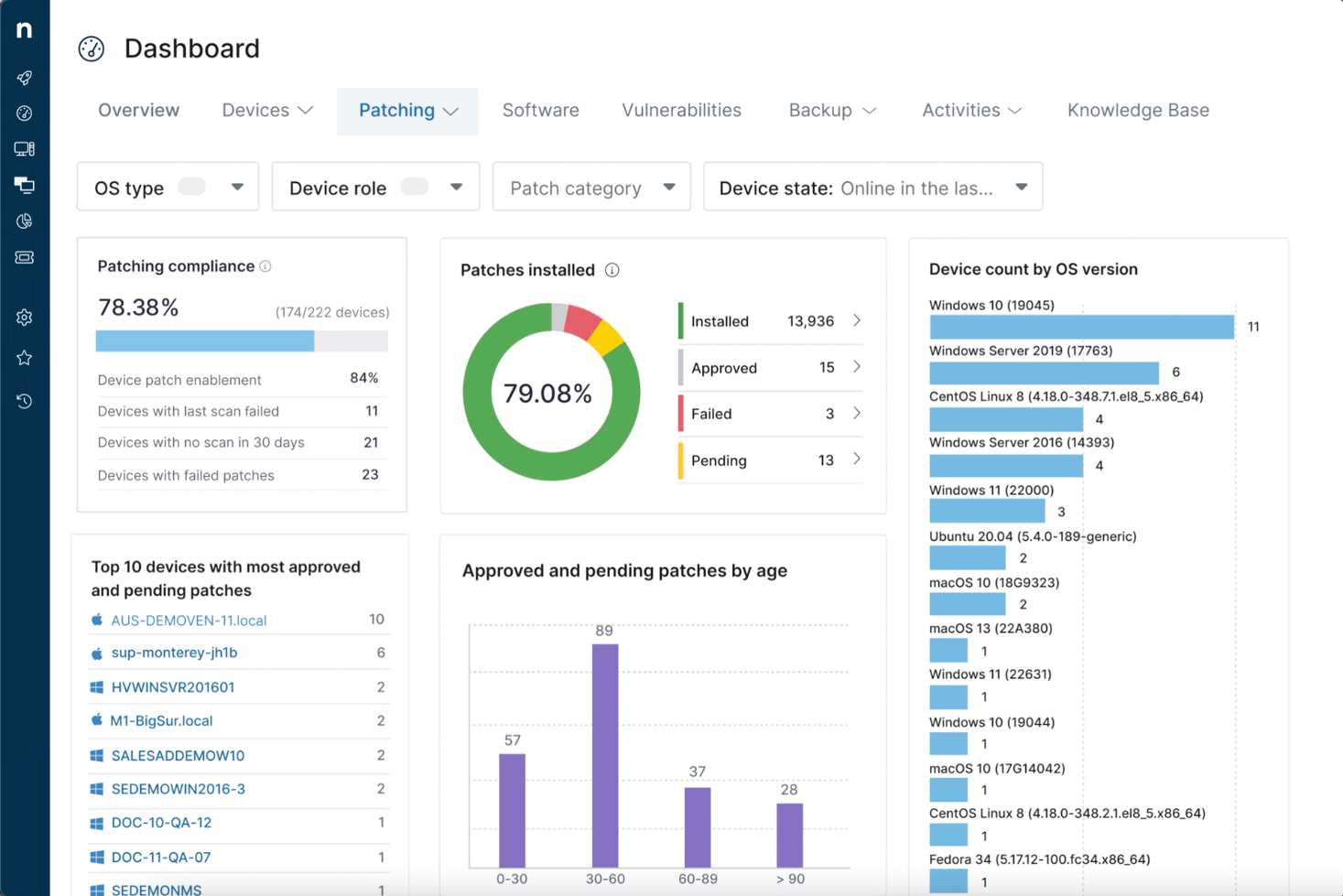
5. NinjaOne
NinjaOne is a unified IT operations platform focused on endpoint management, monitoring, and automation. It provides centralized control over devices and IT processes, helping organizations simplify operations and maintain visibility across distributed endpoints.
Key features include:
Unified endpoint management: Provides visibility and control over endpoints from a single console.
Remote monitoring and management (RMM): Continuously monitors device health and performance.
Automated patch management: Automates software updates and patching processes.
IT automation: Uses AI-driven automation to reduce manual work and improve efficiency.
Integrated backup and security: Supports data protection and endpoint security within the platform.
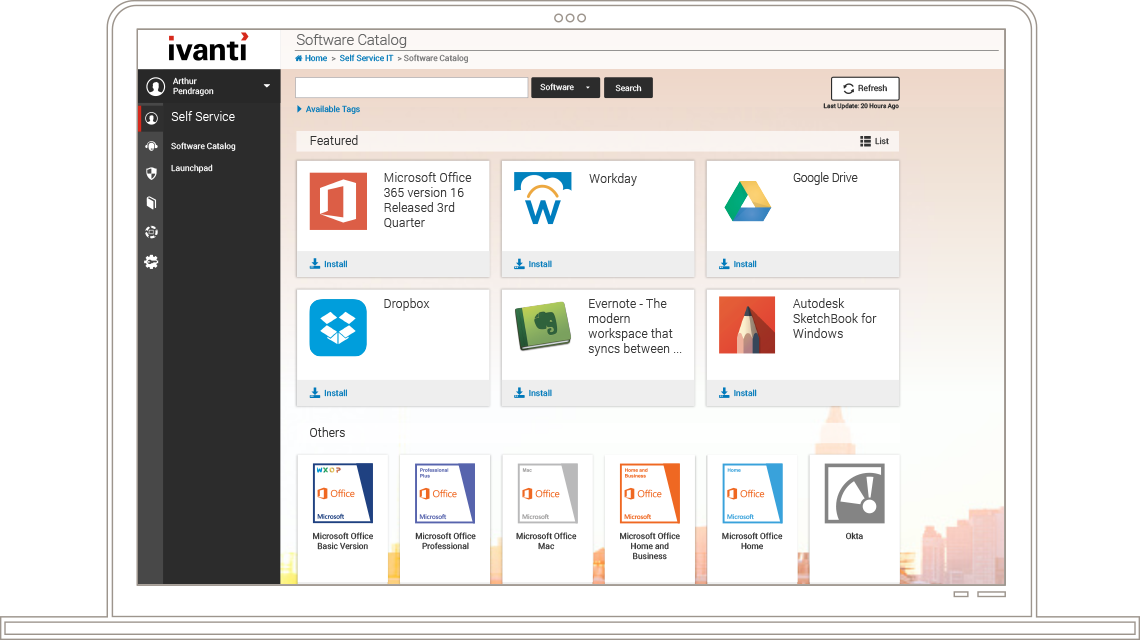
Ivanti is an ITOM and ITSM platform that integrates IT operations, security, and automation into a unified system. It focuses on connecting workflows across IT and security teams while providing centralized visibility and control over endpoints and infrastructure.
Key features include:
Unified IT and security platform: Combines endpoint management, service management, and security operations.
AI-powered automation: Uses AI and analytics to automate workflows and improve operational efficiency.
Centralized visibility: Provides a single view of endpoints, users, and systems across the environment.
Workflow automation: Enables visual and configurable workflows to streamline IT processes.
Exposure and risk management: Identifies vulnerabilities and prioritizes remediation actions.
SolarWinds provides ITOM capabilities focused on monitoring, observability, and incident management across hybrid environments. It supports infrastructure, applications, and databases with tools designed to improve performance and operational resilience.
Key features include:
Comprehensive monitoring: Covers networks, infrastructure, applications, databases, and user experience.
Observability and diagnostics: Provides deep visibility and troubleshooting capabilities across environments.
AIOps capabilities: Uses AI-driven insights to detect issues and support proactive operations.
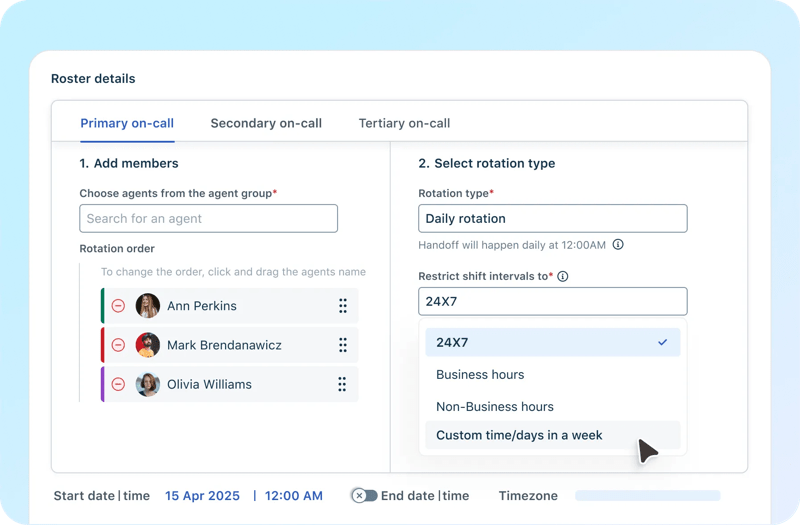
Incident response management: Includes alert correlation, routing, and on-call coordination.
Flexible deployment options: Supports both SaaS and self-hosted implementations.
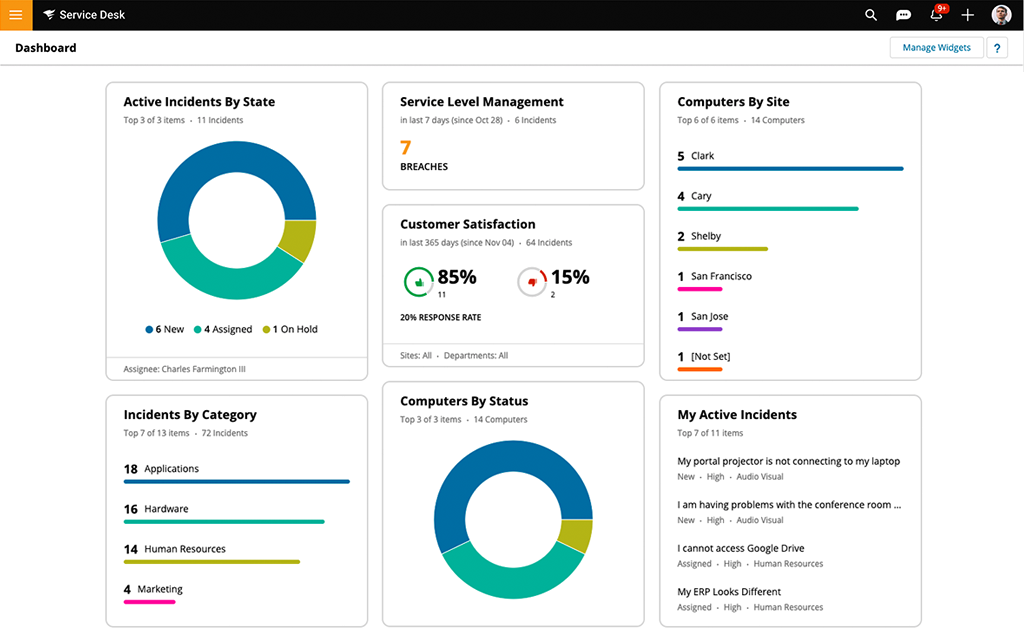
Freshservice is an AI-powered IT service and operations platform that combines ITSM and ITOM capabilities. It provides tools for managing service delivery, assets, and infrastructure with a focus on usability and automation.
Key features include:
AI-powered service management: Uses AI to automate workflows, assist agents, and enable self-service.
Integrated ITOM capabilities: Provides visibility, alerting, and incident resolution across IT environments.
IT asset management and CMDB: Tracks assets and maintains configuration data with automated updates.
Omnichannel support: Enables users to request services and support through multiple channels.
Workflow automation: Automates processes across IT and business teams to improve efficiency.
ITOM software plays a crucial role in modern IT environments, enabling organizations to manage their technology infrastructure effectively, optimize performance, and deliver reliable services to their users. By integrating monitoring, automation, and management capabilities, ITOM software empowers organizations to simplify operations, enhance resilience, and adapt to the demands of dynamic IT environments.