Introducing Ivanti and ServiceNow
Ivanti is an IT software company offering unified endpoint management, IT asset management, and service management solutions. Ivanti products integrate capabilities such as device management, patch management, automation, discovery, and reporting.
ServiceNow is a cloud-based platform primarily focused on IT service management (ITSM), automating workflows, and supporting digital transformation. The platform extends beyond traditional ticketing systems, offering modules for everything from incident and problem management to HR, security operations, and customer service management.
Table of Contents
ToggleThings to know about Ivanti:
- Focus: Specializes in IT asset management (ITAM), IT service management (ITSM), unified endpoint management (UEM), and security solutions.
- Strengths: Strong capabilities in IT asset management and endpoint security, offering deep functionality in these areas. Known for its automation and flexibility, with low-code/no-code configuration options.
- Considerations: May be less comprehensive for organizations with diverse service management needs beyond IT. The platform can be complex for smaller organizations or those with limited IT expertise.
Things to know about ServiceNow:
- Focus: A broad, extensible cloud-based platform for enterprise service management, encompassing IT, HR, and customer service.
- Strengths: Offers a range of modules and advanced functionalities across various enterprise departments, providing a unified platform for diverse service needs. Features robust workflow automation, self-service portals, and strong integration capabilities.
- Considerations: Can be expensive, with subscription models based on users and selected features. The platform’s vastness and complexity can lead to a steep learning curve and a challenging user experience for some.
Key differences at a glance:
- Scope: ServiceNow is a comprehensive enterprise platform for multiple service domains, while Ivanti is more focused on deep IT management capabilities. Complexity vs.
- Specialization: ServiceNow offers broader functionality but can be complex, whereas Ivanti provides specialized depth in IT areas.
- Cost: ServiceNow is generally more expensive and can be overwhelming for smaller organizations.
- User experience: Ivanti’s user interface is sometimes seen as less intuitive than other platforms, though ServiceNow also faces some criticism for being clunky.
Ivanti vs. ServiceNow: Key Differences
1. Feature Comparison
ServiceNow is a full-featured platform with capabilities that extend beyond ITSM. It includes modules for HR, customer service, and security operations. The platform is built around the Now Platform, which allows users to build or extend business apps using low-code tools. ServiceNow supports automation via its Automation Center and predictive analytics through embedded AI.
Some key features include:
- AI-driven incident categorization and ticket routing
- Virtual agents with natural language understanding (NLU)
- Dashboards and KPI tracking
- Integration with third-party services like Salesforce, Amazon Connect, and DevOps tools
Ivanti focuses on operational IT, with tools for endpoint management, asset tracking, and service automation. Ivanti Neurons adds AI and machine learning to detect and resolve issues proactively, reducing human involvement in repetitive tasks. The system includes rapid form creation, auto-deployment options, and integration with collaboration platforms like Slack.
Notable Ivanti capabilities:
- Self-healing workflows for known issues
- Real-time tracking and root-cause analysis
- Asset and configuration management
- Low-code integration via marketplace apps
While both platforms support ITSM fundamentals, ServiceNow has broader functional coverage across departments and industries. Ivanti’s strength lies in task-level automation and endpoint intelligence.
2. Focus and Scope
ServiceNow is for large enterprises that require a centralized platform for managing multiple service areas. Its architecture supports ITIL-aligned processes and cross-functional workflows, including HR onboarding, security incident response, and customer request fulfillment. The platform is often used by global organizations with thousands of employees and a need for unified, scalable service delivery.
Ivanti targets organizations that prioritize endpoint management, IT asset control, and operational automation. Its platform is most beneficial to teams focused on IT services but is adaptable to HR, marketing, and other internal service areas. Ivanti’s Crisis and Remote Work Management modules (developed during COVID-19) show its ability to support broader business continuity use cases, but the tool remains more IT-centered than ServiceNow.
3. Deployment and Scalability
ServiceNow is cloud-native and optimized for scalability across large, complex organizations. The platform handles high data volumes, concurrent users, and complex approval chains. Its deployment is customizable, but that also makes implementation slower and more resource-intensive. Many organizations rely on external consultants or ServiceNow partners to configure the system correctly.
Ivanti emphasizes rapid deployment and faster time-to-value. Its setup process is straightforward, especially for standard use cases, and the auto-deployment feature allows for quick service desk launches. Even non-technical teams can perform basic setups, although deep customization often requires support. Ivanti’s deployment can be on-premises or cloud-based, giving organizations more control over performance.
4. Incident Management
ServiceNow excels in AI-powered incident categorization and ticket assignment. Its Virtual Agent helps users resolve standard issues without waiting for human agents. The Automation Center and predictive intelligence modules simplify recurring tasks and suggest solutions. Incidents are automatically linked to problems and changes, and tracking is centralized in dashboards showing SLA performance and historical metrics.
Ivanti supports multi-channel ticket creation via email, chat, phone, and portal. It offers predefined templates and workflows to simplify ticket creation and escalation. Incidents are prioritized by impact and urgency, with SLA timers and escalation logic built-in. The platform also provides AI recommendations for technicians, real-time dashboards, and automated workflows for recurring incidents.
5. Asset Management
Ivanti has a native asset management system. It tracks both hardware and software, providing visibility into asset status, health, and location. Ivanti’s “Related Item Navigation” feature allows users to explore dependencies between devices, software, and incidents from a single view, especially useful in shared environments. The platform also supports lifecycle tracking, compliance auditing, and automated license management.
ServiceNow manages assets through its CMDB, allowing organizations to track asset relationships and changes over time. It includes automated asset updates, procurement workflows, and financial tracking. ServiceNow can associate assets with service requests, incidents, and changes, creating a unified view for IT and business stakeholders.
6. Request Management
Ivanti provides a customizable self-service portal where users can browse services and submit requests via prebuilt forms. Workflows can be configured to include multi-level approvals and automatic routing. The system also supports automation for resolving frequent request types, reducing manual intervention.
ServiceNow improves request handling with intelligent self-service portals and dynamic forms that adjust based on user roles. The platform routes requests using AI and resolves many through integrated virtual agents. Automation can handle everything from request submission to final resolution, and dashboards track fulfillment metrics and bottlenecks.
7. Cost and Licensing
Ivanti’s pricing is not publicly listed and depends on the scope of deployment and included features. Pricing typically scales with agent count and module selection. The company offers bundled packages covering ITSM, endpoint management, and security. This approach favors smaller or mid-sized businesses, but the opaque pricing makes budget forecasting difficult.
ServiceNow is known for its high cost. Entry-level ITSM pricing starts around $100 per user/month and increases with additional modules like HR or security. The total cost can rise quickly due to customization needs and consulting fees. However, large enterprises often justify the investment due to the platform’s extensive capabilities and integration ecosystem.
Ivanti vs. ServiceNow: Strengths and Weaknesses
ServiceNow strengths
- Broad service management capabilities beyond IT, including HR and customer support
- Scalable architecture for global enterprise use
- Predictive AI and automation tools (e.g., Virtual Agent, Automation Center)
- Extensive integration options (Salesforce, Amazon Connect, DevOps tools)
- Mature ecosystem of third-party apps and strong community support
ServiceNow weaknesses
- High total cost of ownership and lack of transparent pricing
- Long and complex implementation processes
- Steep learning curve for new users and developers
- Performance issues with large data reports or filters
- UI complexity can overwhelm non-technical users
Ivanti strengths
- Fast deployment and low-code configuration
- Automation for asset, incident, and endpoint management
- Real-time asset visibility with intuitive navigation
- Cost-effective for medium-sized businesses
- Built-in self-service tools with Slack integration
Ivanti weaknesses
- Less depth in HR or customer service management
- Smaller integration ecosystem; advanced integrations may need custom work
- UI can feel outdated and less intuitive for new users
- Performance variability in web version vs. on-premise
- Documentation and user community are limited compared to ServiceNow
ServiceNow vs. Ivanti: How to Choose?
Choosing between ServiceNow and Ivanti depends on the organization’s size, IT maturity, required integrations, and long-term digital strategy. While both offer core ITSM capabilities, their architectures, customization paths, and scalability targets differ significantly. Consider the following factors when making a decision:
- Organizational scale and complexity: ServiceNow is suited for large enterprises with cross-departmental service needs and global operations. Ivanti fits mid-sized organizations prioritizing operational efficiency and fast deployment over broad functionality.
- Customization vs. out-of-the-box functionality: ServiceNow supports deep customization, useful for organizations with complex workflows. Ivanti offers quicker setup with built-in templates but may require more effort for advanced or non-standard configurations.
- Endpoint and asset management needs: Ivanti has native strengths in endpoint visibility and asset lifecycle tracking. Choose Ivanti if device and configuration control are central to operations.
- Budget constraints and licensing transparency: Ivanti generally presents a lower total cost of ownership, although pricing lacks transparency. ServiceNow’s costs escalate with added modules and implementation services, making it better suited for organizations with larger IT budgets.
- IT vs. enterprise service strategy: ServiceNow is designed for enterprise-wide service management, extending to HR, customer support, and facilities. Ivanti focuses more narrowly on ITSM and endpoint automation, making it a strong IT operations tool but less viable as a full enterprise platform.
- Resource availability for deployment and maintenance: ServiceNow implementations often need external consultants or a dedicated internal team. Ivanti’s ease of deployment makes it accessible for smaller IT teams, but ongoing support might be limited for non-standard use cases.
- Integration and ecosystem maturity: ServiceNow has a broader ecosystem, supporting robust integrations and third-party apps. Ivanti integrates with popular collaboration tools and offers marketplace apps, but its ecosystem is smaller and may require custom development for complex integrations.
Related content: Read our guide to Ivanti competitors
Faddom: Ultimate Alternative to Ivanti and ServiceNow for Application Mapping
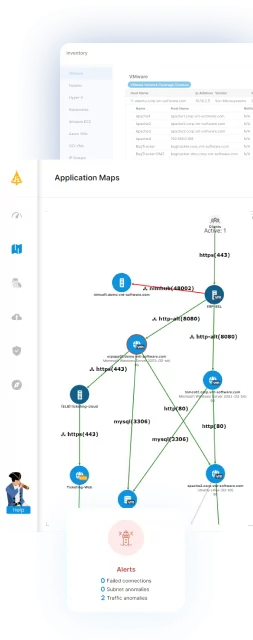
Both Ivanti and ServiceNow rely on accurate configuration data, but many CMDBs quickly become outdated because dependencies shift faster than teams can document them. Faddom automatically discovers every server, application, and dependency across hybrid environments, continuously updating this information to ensure accuracy.
With its native integration with ServiceNow, Faddom automates IT documentation by populating the CMDB with real-time, accurate relationships, which enhance incident resolution, change planning, and asset management. This provides IT teams with the clarity they need to mitigate risks and improve ITSM outcomes.
If you are interested in enhancing the accuracy of your ServiceNow or Ivanti environment, please complete the form on the right to request a demo!