
What Is Cloud Computing?
Cloud computing is the delivery of computing services, including storage, processing, and networking, over the internet (the “cloud”) rather than through local servers or personal devices. This model allows organizations and individuals to access and use shared resources on-demand, with minimal management effort.
There are several key models within cloud computing: infrastructure as a service (IaaS), platform as a service (PaaS), and software as a service (SaaS). Cloud computing eliminates the need for companies to maintain physical servers and infrastructure, while providing access to a range of tools and capabilities that would be expensive and difficult to deploy on-premises.
Cloud services are typically delivered by major cloud providers like Amazon Web Services (AWS), Microsoft Azure, and Google Cloud, but there are also smaller niche providers and hybrid solutions. The cloud provides significant advantages, such as faster deployment, cost savings, scalability, and improved collaboration across teams and locations.
This is part of a series of articles about cloud migration and data center migration
Table of Contents
Toggle6 Trends that Will Shape Cloud Computing Through 2029
Gartner has identified six major trends that will shape cloud computing through 2029, reflecting its evolution from a technical tool to a strategic business platform. These trends highlight growing pressures around cost, compliance, and capability, as well as the expanding role of AI and industry-specific solutions.
- Cloud Dissatisfaction Is Rising
Despite ongoing growth in cloud adoption, many organizations are reporting unmet expectations. Gartner forecasts that by 2028, one in four organizations will face significant dissatisfaction due to poor planning, lack of strategy, or escalating costs. Organizations that take a strategic approach—clarifying business objectives and aligning cloud use accordingly—are more likely to see positive outcomes. - AI and ML Workloads Drive Infrastructure Demand
The demand for AI and machine learning is reshaping how cloud infrastructure is used. By 2029, Gartner predicts that 50% of cloud compute resources will be dedicated to AI workloads, up from less than 10% today. This growth is being fueled by hyperscale cloud providers embedding AI capabilities at the infrastructure level and developing new partnerships to support AI training with real and synthetic data. - Multicloud Complexity Slows Adoption
Many enterprises are adopting multicloud strategies but struggle with interoperability between providers. Gartner expects that more than half of these organizations will fail to realize expected benefits by 2029. To succeed, organizations need to design architectures that support cross-cloud functionality and distributed workloads. - Industry-Specific Platforms Gain Traction
Cloud solutions tailored to specific industries are on the rise. Gartner projects that over 50% of organizations will use these platforms by 2029 to scale digital initiatives. These offerings allow enterprises to integrate specialized capabilities without overhauling their entire IT stack, helping to avoid technical debt while accelerating innovation. - Digital Sovereignty Becomes a Strategic Priority
With stricter data regulations and geopolitical concerns, digital sovereignty is becoming essential. Gartner anticipates that by 2029, more than half of global organizations will have strategies in place to control where their data resides and how it’s accessed. Organizations will need to evaluate their compliance needs and adopt cloud services that offer jurisdictional control and operational transparency. - Sustainability Influences Cloud Decisions
Environmental concerns are becoming a significant factor in cloud strategy. As AI workloads consume more energy, cloud customers and providers are expected to share responsibility for sustainable operations. Gartner estimates that by 2029, over half of global organizations will include sustainability as a key procurement criterion, pushing the industry toward more energy-efficient technologies and responsible resource use.
These trends signal a shift toward more intentional, complex, and regulated cloud environments—requiring organizations to refine their strategies to stay ahead.
Key Cloud Computing Statistics
Global Market Size and Growth
Cloud computing continues to grow as a foundational component of enterprise IT strategies.
1. The global cloud computing market was valued at USD 781.27 billion in 2025 and is projected to reach USD 905.33 billion in 2026
2. By 2034, the market is expected to reach USD 2,904.52 billion, growing at a CAGR of 15.7% from 2026–2034
3. North America held the largest share at 52% of the global market in 2025, driven by early adoption and major cloud providers
4. Asia Pacific is the fastest-growing region due to rapid enterprise digitalization and increasing government investment in cloud infrastructure
Sources: Fortune Business Insights
Cloud Adoption and Spending
Cloud adoption is widespread across industries as companies leverage its benefits for scalability, flexibility, and cost-efficiency. Today, nearly all enterprises use cloud computing in some capacity:
5. 94% of enterprise organizations have at least some workloads in the cloud (Source: RightScale)
6. 33% of organizations are spending over $12 million annually on public cloud services in 2025 (Source: Flexera)
7. 71% of organizations expect their cloud spend to increase in 2025 (Source: Flexera)
8. 58.7% of IT spending is still traditional, but cloud-based spending will soon outpace it (Source: Gartner)
9. 60% of organizations expect their cloud spending to increase slightly in 2025, with 13% expecting a significant increase (Source: Flexera)
Sources: Flexera State of the Cloud Report, Gartner, RightScale State of the Cloud Report
Regional Cloud Adoption Trends
Cloud growth is expanding globally, but each region faces different adoption drivers.
10. U.S. cloud market reached USD 282.62 billion in 2026, with strong digital transformation across sectors
11. Europe projected to reach USD 205.63 billion in 2026, driven by cloud investments and government-backed initiatives like IPCEI CIS
12. Asia Pacific valued at USD 123.40 billion in 2026, with major contributions from China (USD 39.94B), India (USD 20.70B), and Japan (USD 27.86B)
13. Middle East & Africa cloud market projected at USD 62.85 billion in 2026, with growing investments in AI, 5G, and digital infrastructure
14. South America is in a growth phase, driven by expanding internet usage and increasing demand for data storage and processing
Sources: Fortune Business Insights
Technology Trends Shaping Cloud Growth
Emerging technologies are accelerating cloud platform value and driving adoption across industries.
15. The integration of AI, machine learning, and big data is a major growth factor, enabling real-time analytics and predictive automation
16. Generative AI is expected to deliver 75–110% ROI on cloud initiatives through application optimization and workload efficiency
17. Adoption of hybrid cloud is increasing, offering improved flexibility and compliance; public cloud held 55.88% of the market in 2026
18. Omni-cloud strategies are replacing multi-cloud in some enterprises to unify data operations and governance across platforms
Sources: Fortune Business Insights
Cloud Waste
As cloud spending grows, so does the challenge of wasteful spending, which stems from inefficient cloud resource management.
19. 32% of cloud budgets are wasted annually (Source: Flexera)
20. 75% of organizations report an increase in cloud waste as their cloud spend grows (Source: StormForge)
21. 49% of cloud-based organizations struggle to control cloud costs (Source: Anodot)
22. 54% of cloud waste stems from a lack of visibility into costs (Source: Anodot)
23. 66% of organizations report wasted spend due to idle or underused resources (Source: Flexera)
Sources: Flexera State of the Cloud Report, StormForge Cloud Waste Survey, Anodot Survey, VentureBeat
Cloud Computing Models: IaaS, PaaS, SaaS
The cloud market is primarily driven by IaaS, PaaS, and SaaS models, each serving different organizational needs across industries.
24. SaaS will generate $390.5 billion in 2025 (Source: Statista)
25. The IaaS market is growing at a CAGR of 26.2% through 2025 (Source: TechJury)
26. Google Cloud’s IaaS market share reached 11% in 2024 (Source: Statista)
27. PaaS revenue will reach $208.64 billion in 2025 (Source: Statista)
28. IaaS is the fastest-growing segment, outpacing both DaaS and PaaS adoption rates (Source: Bure Valley Group)
Sources: TechJury, Statista, Blue Valley Group
Cloud Strategies: Public vs. Private vs. Hybrid vs. Multicloud
Organizations are increasingly adopting multicloud and hybrid cloud strategies to improve flexibility, scalability, and security.
29. 80% of organizations use multiple public cloud providers (Source: Virtana)
30. 73% of organizations have adopted a hybrid cloud approach (Source: Flexera)
31. 59% of tech leaders use hybrid or multicloud for security (Source: Zesty)
Sources: Virtana, Flexera State of the Cloud Report, Zesty CIO and CTO Survey Report, O’Reilly
Cloud Applications and Workloads
Cloud applications and workloads continue to expand as organizations migrate more services to the cloud.
32. The average company uses 254 SaaS apps (Source: Productiv)
33. Enterprises use an average of 364 SaaS apps (Source: Productiv
34. 68% of SaaS sprawl occurs in companies with fewer than 500 employees (Source: Productiv)
Sources: Productiv
Cloud Security
Security remains a top concern for cloud users, with organizations focusing on protecting their cloud infrastructure and data.
35. 96% of companies are concerned about cloud security (Source: Fortinet)
36. 41% of security leaders consider lack of awareness the top barrier to cloud security (Source: Fortinet)
37. 61% of organizations report breaches within the last 12 months (Source: Miratech)
38. 68% of security incidents in public clouds are caused by misconfiguration (Source: Fortinet)
39. 41% of organizations are implementing zero-trust security policies (Source: Fortinet)
Sources: Fortinet 2024 Cloud Security Report, Miratech,
Cloud Challenges
Cloud adoption presents several challenges, from managing costs to integrating new technologies.
40. 84% of cloud decision-makers cite managing cloud spend as their main challenge (Source: Flexera)
41. 49% of organizations face cloud waste issues due to overprovisioning (Source: Anadot)
42. 56% of enterprises report lack of control as a barrier to cloud adoption (Source: Fortinet)
Sources: Flexera, Anadot, Fortinet Cybersecurity Insiders Cloud Report
Visibility for Cloud Computing Environments with Faddom
As cloud adoption continues to grow, statistics reveal not only the significant investment involved but also the challenges related to cost control, visibility, and security. Many organizations face issues such as cloud waste, misconfigurations, and unmanaged SaaS sprawl due to a lack of visibility into their hybrid and multi-cloud environments. This is where Faddom can help.
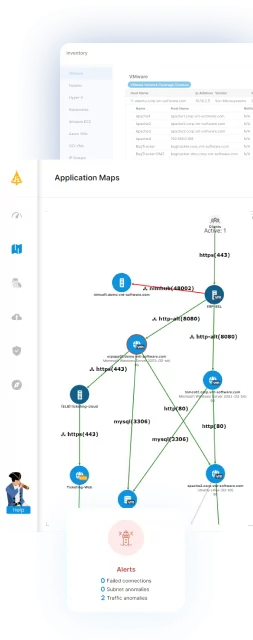
Faddom is an agentless application dependency mapping platform that offers real-time visibility into servers, applications, and traffic flows across cloud, on-premises, and hybrid infrastructures. By automatically discovering resources and their dependencies, it enables IT teams to reduce waste, enhance cloud security, and maintain compliance. With Faddom, organizations can pinpoint underutilized assets, segment environments to prevent lateral movement, and establish a single source of truth for informed decision-making.
Book a demo today to see how Faddom can eliminate cloud blind spots and optimize your environment!