What Is SolarWinds?
SolarWinds is a provider of IT management software designed for monitoring and managing network infrastructure, systems, and applications. Founded in 1999, the company serves a wide range of customers, from small businesses to large enterprises and government organizations.
Its products are known for providing in-depth visibility into networks, servers, databases, and application performance, helping organizations maintain uptime and resolve issues faster. Over the years, SolarWinds has expanded its product offerings to cover various IT needs, including network performance monitoring, configuration management, IT service management, and security event management.
SolarWinds solutions can be deployed both on-premises and in the cloud, allowing businesses to choose the architecture that best suits their requirements. Its products integrate easily with third-party systems, which adds to their flexibility for complex IT environments.
Table of Contents
ToggleChanges in Solarwinds Pricing in Recent Years
SolarWinds has undergone a major shift in its licensing and pricing model over the last few years, moving away from perpetual licenses to a subscription-only structure. Between 2022 and 2024, the company began introducing subscription options alongside perpetual licenses for select modules. However, following the April 2025 acquisition by Turn/River, the transition accelerated. By August 1, 2025, SolarWinds officially enforced a three-year subscription-only model across its product line, including Orion modules like NPM, SAM, NCM, and NTA, as well as the Observability platform.
Increased costs for many customers
Post-acquisition, renewal fees reportedly rose by as much as 300%. Existing customers with perpetual licenses are being steered toward multi-year subscriptions, often bundled into higher-tiered packages like Hybrid Cloud Observability (HCO). These bundles remove the flexibility to purchase modules individually and can force customers to buy features they don’t need. For teams that only used specific Orion modules, this change has meant paying more for less targeted functionality.
Another cost driver has been the change in how licenses are consumed. In the latest SolarWinds Platform (2025.1), routine actions such as enabling WMI polling or User Device Tracking can trigger additional license consumption without warning. These unexpected increases can exceed license thresholds mid-renewal, blocking new additions until more licenses are purchased. This unpredictability in usage and billing complicates budgeting and may lead to sudden, unplanned expenses.
Organizations planning infrastructure expansions or renewals are especially at risk of budget overruns. Adding new nodes or scaling up in the cloud can automatically move customers into a higher subscription tier, with price increases ranging from 50% to 100%. Additionally, initial subscription discounts may not carry over at renewal, leading to significant cost hikes once the contract is up.
Understanding Solarwinds Pricing
Monitoring and Observability
SolarWinds offers multiple solutions for monitoring and observability, available as both SaaS and self-hosted options.
SolarWinds Observability SaaS is designed to simplify management of hybrid and cloud-native environments. It provides unified visibility across applications, microservices, containers, and Kubernetes. By consolidating data from metrics, logs, traces, and user experience into one platform, it enables faster insights and troubleshooting. The solution also supports extensibility through public APIs, open-source frameworks, and third-party integrations. A 30-day free trial is available.
SolarWinds Observability Self-Hosted delivers full-stack observability for on-premises, hybrid, and cloud environments. It offers deep visibility into networks, servers, applications, and databases, and supports monitoring across major cloud platforms including Azure, AWS, and Google Cloud. The platform allows flexible deployment and scaling, with licensing starting at $7.42 per node per month. A 30-day trial is available.
Storage Resource Monitor (SRM) focuses on multi-vendor storage monitoring. Built on the SolarWinds Platform, SRM enables performance and capacity planning, along with alerting and hotspot detection. Pricing starts at $2,970 for a self-hosted deployment.
IT Service Management
SolarWinds provides two IT service management solutions, available as SaaS and self-hosted options.
Service Desk is a cloud-based ITSM platform starting at $39 per technician per month, with support for unlimited end users. It includes incident management to simplify ticket handling, a standardized service catalog for request fulfillment, and integrated asset management to track hardware, software, purchase orders, and more. A 30-day free trial is available.
Web Help Desk is a self-hosted help desk and asset management solution starting at $533. It supports unlimited end users and includes features for automating ticket workflows, centralizing knowledge base content, and tracking service-level agreements (SLAs). A 14-day trial is available.
Database
SolarWinds offers two self-hosted solutions for database performance monitoring and optimization.
SQL Sentry is built for diagnosing and resolving SQL Server performance issues. It supports environments including SSAS, Azure SQL Database, and Azure Synapse SQL Pools. The tool is scalable, with proven deployments monitoring over 800 SQL Server instances. It provides detailed performance metrics and deep-dive analytics for identifying and resolving bottlenecks. Pricing starts at $1,999, with a 14-day trial available.
Database Performance Analyzer (DPA) is a cross-platform monitoring tool for SQL query performance analysis and tuning. It operates agentlessly with under 1% resource overhead and supports both Windows and Linux environments, including deployments on Azure and AWS. DPA also offers expert insights for query tuning and table optimization. Pricing starts at $1,699 with subscription licensing options and a 14-day trial.
Incident Response
Incident Response by Squadcast is a SaaS-based platform to simplify and improve operational incident management. Starting at $9 per user, it helps teams reduce alert fatigue and manual workloads through intelligent alert routing, AI-generated summaries, and automated workflows.
The platform supports fair on-call scheduling, faster escalations, and smoother handoffs to improve team performance and reduce burnout. By accelerating every stage of incident handling (from detection to resolution) it lowers both mean time to acknowledge (MTTA) and mean time to resolve (MTTR). Real-time service level objective (SLO) tracking, error budgeting, and unified service insights help teams maintain uptime and stay proactive. A fully functional 14-day free trial is available.
SolarWinds Self-Hosted Tools
SolarWinds provides a broad set of self-hosted tools for remote support, network diagnostics, configuration management, and secure file transfers.
Dameware Mini Remote Control starts at $370 and supports unlimited end devices with no monthly fees. Dameware Remote Support, starting at $520, adds centralized IT administration features, also with no per-device limits.
Engineer’s Toolset ($1,997) includes over 60 network tools for diagnostics and troubleshooting. Kiwi CatTools ($1,095) automates network configuration backups and device change management. Kiwi Syslog Server NG, priced at $999, offers centralized syslog collection and alerting with no recurring fees.
Network Topology Mapper ($1,977) automatically generates network maps by scanning connected devices and relationships.
For secure file transfers, Serv-U File Transfer Protocol Server ($666) and Serv-U Managed File Transfer Server ($4,019) support unlimited concurrent sessions, helping organizations manage file sharing securely across internal and external endpoints.
Each of these tools comes with a 14-day fully functional trial.
Solarwinds Limitations
While SolarWinds offers a broad suite of IT management tools, there are several limitations that customers, particularly those in complex or growing environments, should be aware of. These limitations were reported by users on the G2 platform:
- High initial complexity: Setting up and configuring SolarWinds can require deep technical knowledge. Deployment may take longer than expected, especially when fine-tuning advanced features like alerting or automation.
- Limited ITSM integration: Out of the box, SolarWinds only integrates with ServiceNow. Connecting to other ITSM systems requires custom development, adding to deployment time and support overhead.
- Customizability gaps: While the platform offers many features, some parts of SolarWinds Observability still lack flexibility. Certain polling intervals, such as hardware monitoring for vCenter, are fixed and not user-configurable.
- Reliability issues: Inconsistent behavior in alerting and polling has been reported, especially since the 2024 releases. For example, alerts may fail to trigger until manually reviewed.
- Performance bottlenecks: Some modules, such as IP Address Manager (IPAM), have performance issues when managing large data sets. Operations like moving subnets can feel slow and inefficient even in newer versions.
- Steep learning curve: While the interface is relatively user-friendly, mastering SolarWinds, especially for advanced use cases, requires time and training. New users often struggle with the volume of options and features available.
- Weak support for custom integrations: Tools like SWQL Studio are under-documented. Users report a lack of resources and support when building or troubleshooting custom integrations.
- Aggressive sales tactics: SolarWinds has earned a reputation for persistent upselling and frequent sales turnover. Many users find the renewal process frustrating and avoid engaging with sales except when necessary.
- Pricing concerns: The cost of ownership is high, particularly for small teams or those who only need a few modules. Bundled pricing models can lead to paying for features that aren’t used.
- Interface inconsistencies: Some areas of the platform feel outdated compared to newer tools, and the overall user experience can vary between modules.
Related content: Read our guide to SolarWinds alternatives (coming soon)
Faddom: Affordable Solarwinds Alternative for Application Dependency Mapping
As licensing models evolve and subscription structures change, many organizations are reassessing how they balance cost, flexibility, and operational visibility. Predictable budgeting, streamlined deployment, and clarity around what is being paid for have become increasingly important when evaluating infrastructure management tools.
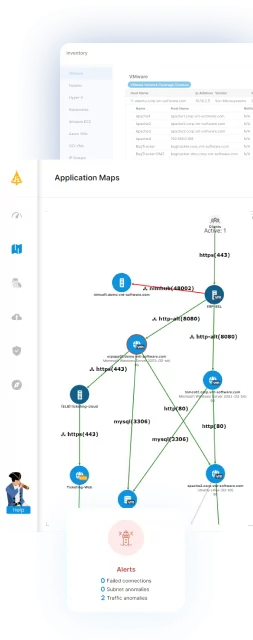
Faddom offers a focused approach to application dependency mapping, providing agentless, real-time visibility into how servers and applications communicate across hybrid environments. With transparent per-server pricing and fast deployment, it helps enterprises support change initiatives, reduce operational risk, and maintain accurate infrastructure insight without unnecessary complexity.