
A cybersecurity framework is a structured set of guidelines to secure information systems and manage cybersecurity risks. Various frameworks outline policies and procedures that organizations can implement to secure their digital assets. By following a cybersecurity framework, organizations create a stronger defense against cyber threats.
Organizations benefit from cybersecurity frameworks as they provide a consistent methodology for assessing and mitigating risks. They help in standardizing security practices across industries, ensuring compliance with regulatory requirements. Frameworks are adaptable, enabling organizations to tailor their security strategies based on the most relevant challenges and available resources.
Table of Contents
ToggleThe Urgent Need for Cybersecurity Framework
Cybersecurity threats are evolving rapidly, targeting vulnerabilities across systems, networks, and applications. Without a structured approach, organizations often struggle to detect, prevent, or respond effectively to these risks. A cybersecurity framework provides that structured approach, helping organizations align their security efforts with recognized best practices.
Below are key reasons why a cybersecurity framework is essential:
- Risk Identification and Management: Frameworks help organizations systematically identify, assess, and prioritize cybersecurity risks. This structured risk management approach reduces blind spots and supports proactive defense.
- Regulatory Compliance: Many industries are governed by data protection laws and security standards. Frameworks such as NIST and ISO 27001 help organizations align with these regulations, reducing legal exposure.
- Standardized Security Practices: A cybersecurity framework promotes consistency in implementing security controls. It ensures all teams follow the same baseline procedures, minimizing gaps caused by inconsistent practices.
- Improved Incident Response: Frameworks often include guidelines for detection, response, and recovery from cyber incidents. This preparation enables faster containment and recovery when attacks occur.
- Stakeholder Confidence: Demonstrating adherence to a recognized framework can build trust with customers, partners, and regulators. It shows that the organization is taking cybersecurity seriously.
- Scalability and Flexibility: Frameworks are typically adaptable to an organization’s size, industry, and risk profile. This makes them useful for both small businesses and large enterprises with complex infrastructures.
- Foundation for Continuous Improvement: Frameworks encourage continuous monitoring, evaluation, and enhancement of security measures. This helps organizations keep pace with emerging threats and evolving technologies.
Key Components of a Cybersecurity Framework
Cybersecurity frameworks typically include the following components.
Identification
The identification component of a cybersecurity framework involves recognizing and understanding assets that need protection. It requires cataloging hardware, software, and data infrastructures to assess their vulnerabilities. By identifying these assets, organizations establish a baseline of critical resources that must be protected against cyberthreats.
This process informs subsequent protective strategies and measures implemented within the framework. Regular audits and asset inventories are necessary to maintain an up-to-date understanding of the organization’s cybersecurity landscape. Identification extends beyond assets; it includes assessing potential risks and threat vectors.
Protection
Protection involves implementing safeguards to ensure the integrity and security of information systems. Measures such as access controls, encryption, and network security are deployed to prevent unauthorized access and data breaches. These measures focus on preventing attacks and vulnerabilities, addressing the identified risks associated with the organization’s assets.
Protection strategies need to be scalable and flexible, reflecting the changing landscape of cyber threats. This requires a dynamic approach, incorporating the latest technologies and threat intelligence. Training staff on security best practices is also integral to protective measures, as human error remains a significant vector for breaches.
Detection
Detection involves monitoring systems to identify suspicious activities or breaches quickly. Employing technologies like intrusion detection systems (IDS) and continuous monitoring tools, organizations can detect anomalies that signal potential security incidents. The speed at which threats are detected directly affects the impact and recovery from breaches.
Properly configured detection mechanisms enable prompt responses, minimizing potential damages to systems and data. Organizations must fine-tune detection tools to differentiate between false alarms and genuine threats, demanding accurate threat intelligence and analysis capabilities.
Response
Response refers to the actions taken once a threat or breach is identified. It involves executing a predefined incident response plan, which outlines the steps and responsibilities for managing and mitigating cyber incidents. A timely and effective response minimizes disruption and damage, restoring normal operations quickly.
The response phase is crucial for limiting the adverse effects of security incidents on the organization’s operations. Incident response plans should be regularly tested and updated to reflect organizational changes and emerging threats. A thorough response strategy includes communication plans to ensure stakeholders are informed throughout the incident.
Recovery
Recovery focuses on restoring systems and operations to their normal state after a cybersecurity incident. It includes steps to repair and improve systems to prevent future incidents. Recovery planning is vital for minimizing downtime and resource loss. Lessons learned from incident analysis feed back into the framework to improve resilience.
A well-defined recovery plan enables organizations to resume critical operations swiftly. It should detail processes for data restoration, system reconfiguration, and revisiting security policies. By incorporating recovery strategies in the cybersecurity framework, organizations ensure a holistic approach that enables swift recovery if breaches occur.
Notable Cybersecurity Frameworks
1. NIST Cybersecurity Framework
The NIST Cybersecurity Framework provides a policy framework for computer security guidance classified as critical infrastructure controls. Developed by the National Institute of Standards and Technology, it offers structured planning, covering identification, protection, detection, response, and recovery. This voluntary framework aids organizations in aligning security activities with business requirements, integrating risk management strategies.
The NIST framework emphasizes flexibility, allowing organizations to tailor its components to their needs. It helps improve cybersecurity risk management by promoting the adoption of industry best practices. Organizations choose NIST due to its nature and integration capabilities.
2. ISO/IEC 27001 and 27002
ISO/IEC 27001 and 27002 are international standards forming a cornerstone for information security management systems worldwide. ISO 27001 focuses on developing an overarching management framework, while ISO 27002 provides guidelines on implementing controls. Together, they offer structured risk management aligned with organizational objectives, ensuring continuous improvement and information security.
These standards are widely recognized, helping organizations ensure confidentiality, integrity, and availability of information. Certification to these standards demonstrates commitment to information security and is often demanded by partners and customers.
3. CIS Critical Security Controls
The CIS Critical Security Controls (CSCs) provide a prioritized set of actions to protect organizations from known cyber risks. These controls provide clear guidance on implementing security strategies, focusing on critical areas that can significantly improve an organization’s cyber defense. The controls are updated regularly, reflecting the evolving threat landscape and providing a roadmap for security improvements.
CIS controls are appreciated for their focus on practical, actionable measures. Organizations often use them to prioritize security efforts, focusing on the most impactful actions to reduce vulnerabilities. These controls form a baseline for cyber defense, helping organizations simplify their security efforts and allocate resources efficiently to improve their security posture.
4. SOC 2 Compliance
SOC 2 compliance is a framework focused on ensuring that service providers securely manage data to protect the privacy of their clients. Developed by the American Institute of CPAs (AICPA), SOC 2 reports assess the effectiveness of an organization’s controls related to security, availability, processing integrity, confidentiality, and privacy.
Compliance with SOC 2 is crucial for service organizations, especially those handling sensitive client information. Organizations seeking SOC 2 compliance undergo rigorous auditing processes to validate their security controls. Achieving compliance demonstrates a high standard of information security, building customer trust and competitive advantage.
5. NIST AI Risk Management Framework (AI RMF)
The NIST AI Risk Management Framework helps organizations identify, assess, and manage risks associated with the use of artificial intelligence systems. Designed to promote trustworthy and secure AI adoption, the framework outlines structured processes across core functions—such as governance, risk mapping, measurement, and risk management—to integrate AI risk considerations into organizational practices.
It supports both operational teams and leadership in building AI systems that are resilient to adversarial threats, compliant with ethical and legal requirements, and aligned with broader cybersecurity strategies.
6. Cybersecurity Maturity Model Certification (CMMC)
The Cybersecurity Maturity Model Certification (CMMC) is a unified standard for implementing cybersecurity across the defense industrial base. It aims to secure controlled unclassified information (CUI) shared among contractors and subcontractors in defense contracts. The CMMC model consists of maturity levels that reflect an organization’s cybersecurity capabilities, ranging from basic cyber hygiene to advanced security measures.
CMMC’s phased maturity levels guide organizations toward progressively implementing more sophisticated cybersecurity practices. Achieving CMMC certification is essential for organizations wanting to engage with U.S. Department of Defense contracts. The model underscores the significance of layered security controls and frequent assessments.

Lanir specializes in founding new tech companies for Enterprise Software: Assemble and nurture a great team, Early stage funding to growth late stage, One design partner to hundreds of enterprise customers, MVP to Enterprise grade product, Low level kernel engineering to AI/ML and BigData, One advisory board to a long list of shareholders and board members of the worlds largest VCs
Tips from the Expert
In my experience, here are tips that can help you effectively implement and maximize the benefits of cybersecurity frameworks:
- Customize frameworks to industry-specific risks: Tailor standard frameworks like NIST or ISO 27001 to address threats in the relevant industry. For example, healthcare organizations should focus on HIPAA-related compliance, while financial firms may prioritize PCI DSS.
- Map multiple frameworks for cross-compliance: Combine elements from various frameworks to achieve broader compliance. For instance, align NIST CSF with ISO 27001 for global consistency while meeting localized or industry-specific standards.
- Implement threat modeling during the identification phase: Go beyond basic asset inventory by using threat modeling to understand potential attack vectors. This proactive approach improves prioritization and strengthens defenses around critical assets.
- Automate incident detection and response: Use Security Orchestration, Automation, and Response (SOAR) tools to simplify detection and incident management. Automated workflows help reduce response times and improve accuracy during critical events.
- Establish a baseline for normal behavior: Develop baselines for system and network activity to help differentiate between normal operations and potential threats. Anomalies against these baselines can serve as early indicators of breaches.
7. Control Objectives for Information and Related Technology (COBIT)
COBIT is an IT management framework developed to help organizations develop, organize, and implement strategies for information management and governance. The framework outlines processes and controls that improve governance and management effectiveness. COBIT assists organizations in aligning their IT goals with strategic business objectives and managing risk while optimizing resource use.
It’s particularly valuable for auditing and regulatory compliance. Organizations can adapt COBIT practices to their contexts, improving IT governance and driving value from technology investments. Its broad applicability makes COBIT a preferred framework for enterprise IT governance.
8. Health Information Trust Alliance (HITRUST)
The HITRUST Common Security Framework (CSF) offers an approach to regulatory compliance and risk management. HITRUST is widely used in the healthcare industry to address data protection and compliance challenges. It combines federal regulations, state laws, and industry standards into a single framework.
Organizations benefit from HITRUST by ensuring compliance with complex healthcare regulations. It supports healthcare practices by providing guidelines to protect electronic health records and manage data privacy.
9. Cloud Control Matrix
The Cloud Security Alliance (CSA) developed the Cloud Control Matrix (CCM), a cybersecurity control framework for cloud computing. It outlines cloud-specific security controls, aiding providers and users in assessing and managing cloud security risks. The CCM helps organizations comply with regulatory requirements and manage risk in cloud implementations.
It’s a tool for evaluating the security posture of cloud services and improving security practices. By implementing the CCM, organizations can improve cloud security alignment and better manage data protection and privacy in their cloud environments, protecting against unique cloud vulnerabilities.
Learn more in our detailed guide to cloud network security
10. NERC-CIP
The North American Electric Reliability Corporation’s Critical Infrastructure Protection (NERC-CIP) standards are designed to secure the assets responsible for operating North America’s bulk electric system. These standards cover areas such as electronic security perimeters, incident response, and recovery.
Organizations involved in electric grid operations apply NERC-CIP standards to ensure the reliability and security of their infrastructure. Compliance with these standards is critical for protecting the power grid from cybersecurity threats. NERC-CIP helps entities manage risks associated with critical infrastructure, supporting regulatory compliance and physical and cyber security integration.
11. FISMA
The Federal Information Security Management Act (FISMA) mandates an approach to securing U.S. government information. It requires agencies to develop, document, and implement an information security program, aligning with national security objectives.
FISMA compliance improves the protection of government data by setting mandatory security standards. Agencies establish risk management processes to protect assets, focusing on protecting critical federal systems. FISMA promotes accountability through regular reviews and reporting, ensuring continuous improvements in information security.
Best Practices for Adopting a Cybersecurity Framework
Here are some important practices to consider when adopting a cybersecurity framework.
1. Conduct Regular Risk Assessments
Regular risk assessments aid in identifying vulnerabilities, evaluating the impact of potential threats, and informing security strategies. They provide insights into the current security landscape and help prioritize resources to mitigate risks. Organizations must conduct assessments to adapt security measures to evolving threats.
Risk assessments should involve evaluating the organization’s technological assets, data, and processes. By systematically identifying weaknesses, organizations can implement countermeasures to address identified threats. Regular assessments can reveal areas requiring improvement, guiding strategic decisions and reinforcing an organization’s security capabilities.
2. Engage Stakeholders Across the Organization
Engaging stakeholders in cybersecurity efforts is necessary for aligning security practices with organizational objectives. This engagement ensures that security measures are integrated into business processes. By including representatives from different departments, organizations gain diverse perspectives and foster collaboration in developing security strategies.
Stakeholder engagement emphasizes the importance of security in the overall business strategy. It ensures that cybersecurity considerations are factored into decision-making processes, including IT investments and project management. Engaging stakeholders promotes shared responsibility, encouraging a proactive security mindset across the organization.
3. Provide Employee Training and Awareness
Employee training and awareness programs are vital components of a successful cybersecurity strategy. Educating employees on potential risks, safe practices, and response plans reduces the likelihood of human error leading to security incidents. Regular training sessions should be implemented to keep staff informed about the latest threats and necessary precautions.
Organizations benefit from fostering a security-aware culture where employees understand their role in protecting information assets. Effective training programs provide employees with the skills and knowledge needed to recognize and report suspicious activities. These efforts contribute to a more resilient organization, helping defend against internal and external threats.
4. Continuous Monitoring and Improvement
Continuous monitoring and improvement involve regularly reviewing and updating security measures to keep pace with a dynamic threat environment. This approach includes real-time monitoring tools and techniques to detect anomalies, breaches, or threats. By continuously monitoring, organizations can respond swiftly to incidents, minimizing potential damage.
Improvement entails analyzing past incidents and trends to refine security practices and policies. It encourages lifecycle management in cybersecurity, integrating feedback to improve defense mechanisms. Organizations that prioritize continuous improvement demonstrate resilience against emerging threats, maintaining robust and up-to-date security defenses.
5. Align Cybersecurity with Business Objectives
Aligning cybersecurity with business objectives ensures that security initiatives support and enable organizational goals. This alignment balances security investments with operational priorities, integrating cybersecurity into the core business strategy. It improves business resilience while ensuring compliance with regulatory requirements.
Organizations should communicate the value of cybersecurity in the context of strategic planning and decision-making processes. By aligning security practices with business goals, they can better allocate resources, improve risk management, and improve productivity. This alignment fosters an environment where security is viewed as a business enabler.
6. Integrate AI-aware Security Controls
Artificial intelligence is reshaping cybersecurity on both the defensive and offensive sides, expanding attack surfaces and introducing novel vulnerabilities traditional controls weren’t designed to address. To manage these AI-related risks effectively, organizations should adopt security controls and processes that explicitly account for AI implementations and potential misuse.
This includes incorporating AI risk assessments into broader cybersecurity risk management, using AI-driven threat detection tools to augment monitoring, and aligning with emerging AI-specific frameworks such. By systematically addressing the unique characteristics of AI (e.g., model behavior, data integrity, adversarial risks), organizations can better secure AI assets and bolster overall resilience against advanced threats.
Supporting Cybersecurity Frameworks with Faddom Application Mapping
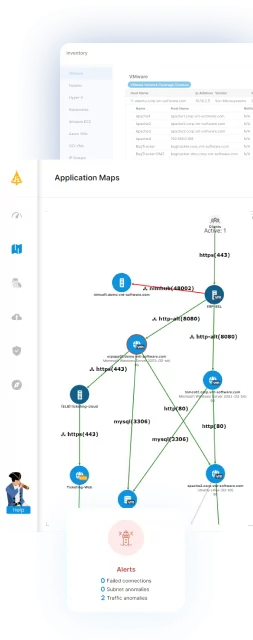
Faddom enhances the adoption of cybersecurity frameworks by providing precise and real-time visibility into your IT infrastructure. With Faddom’s agentless application dependency mapping, organizations can:
- Identify critical assets and dependencies: Map all applications, servers, and connections to create a comprehensive inventory for risk assessments and proactive security measures.
- Strengthen detection and monitoring: Monitor network traffic and identify anomalies, helping organizations implement robust detection capabilities as outlined in frameworks.
- Streamline incident response: Visualize the impact of security incidents across your hybrid infrastructure, enabling faster response and recovery.
- Simplify compliance and audits: Generate detailed reports and documentation to support compliance.
- Align security with business objectives: Use Faddom’s real-time insights to ensure security practices support operational needs, minimize disruptions, and optimize resource use.
Faddom empowers organizations to manage cybersecurity more effectively, ensuring that frameworks are implemented and optimized for dynamic and complex IT environments.
Learn how Faddom can simplify your cybersecurity journey today!