
What Are Vulnerability Management Tools?
Vulnerability management tools are software used to identify, assess, and manage security weaknesses in IT systems. These tools offer a systematic approach to inspect an organization’s network and digital assets for vulnerabilities that could be exploited by cyber threats.
The primary goal is to reduce risks associated with vulnerabilities before they can be leveraged by attackers. This is a crucial part of an organization’s cybersecurity posture, ensuring that proactive measures are taken against potential security breaches. These tools include various functionalities that address different aspects of vulnerability management.
From scanning systems for known vulnerabilities to providing guidance on remediation, each tool aids in maintaining system integrity. Their importance has grown with the increasing complexity of IT environments and the evolving nature of cybersecurity threats.
Editor’s note: Updated all product information to reflect features and capabilities in 2026.
This is part of a series of articles about IT Asset Management
Vulnerability Management Tools at a Glance: Comparison Table
|
Product |
Key Strengths |
Things to Consider |
|
Faddom |
Agentless real-time discovery; application dependency mapping; CVE and SSL monitoring; strong integrations; supports compliance (DORA, NIS2) |
Focused on visibility and mapping rather than deep exploit testing; relies on integrations for some workflows |
|
CrowdStrike Falcon Spotlight |
Scanless, single-agent architecture; AI-powered prioritization (ExPRT.AI); real-time CVE detection; integrated SOAR workflows |
Requires Falcon platform; best value within CrowdStrike ecosystem; agent dependency |
|
Intruder |
Strong attack surface discovery; risk-based prioritization using EPSS/CISA KEV; cloud posture checks; private bug bounty option |
Less depth in endpoint agent capabilities; premium features may increase cost |
|
ThreatMapper (Deepfence) |
Open-source CNAPP; full-stack scanning (containers, Kubernetes, serverless); ThreatGraph prioritization; eBPF observability |
Requires in-house expertise to deploy/manage; enterprise support may require paid options |
|
Rapid7 InsightVM |
Hybrid scanning (agent + agentless); Active Risk scoring; strong remediation workflows; extensive integrations |
Can require tuning for large environments; licensing complexity for broad deployments |
|
Qualys VMDR |
Unified asset discovery + remediation; TruRisk scoring; native patching; strong compliance coverage |
Cloud-agent reliance; configuration complexity in large enterprises |
|
Cisco Vulnerability Management |
Predictive exploit forecasting; strong threat intelligence integration; SLA tracking; clear risk reporting |
Relies on ingestion from other scanners; not a primary scanning engine |
|
Tenable Nessus |
Extensive CVE coverage; large plugin library; flexible deployment; strong scoring models (VPR, EPSS, CVSS v4) |
Primarily point-in-time scanning; enterprise scaling requires additional Tenable products |
|
ManageEngine Vulnerability Manager Plus |
Integrated patching; configuration management; compliance auditing; cross-platform support |
UI and scalability may vary in very large enterprises; agent management overhead |
|
OpenVAS (Greenbone) |
Fully open-source; customizable tests; daily updated feed; credentialed and non-credentialed scans |
Requires significant setup and tuning; limited enterprise workflow automation out-of-the-box |
Key Features of Vulnerability Management Tools
Vulnerability management tools typically include the following capabilities.
1. Asset Discovery and Inventory
The vulnerability management process begins with identifying all IT assets within an organization’s network. This includes hardware components, virtual entities, applications, and network components. Asset discovery ensures that no element is overlooked, allowing security teams to have a complete view of their technology environment.
This step is critical because unidentified assets could harbor vulnerabilities that an attacker might exploit. Once assets are discovered, maintaining an accurate inventory becomes essential. Regular updates to this inventory reflect changes, such as the addition of new devices or applications, ensuring the organization always has current data to work with.
2. Vulnerability Scanning
Vulnerability scanning involves systematically examining networks and systems for known vulnerabilities. These scans leverage databases of known threats, comparing them against an organization’s assets to identify weak points. This process can be scheduled at regular intervals or conducted on-demand, allowing for both periodic health checks and immediate assessments.
The effectiveness of vulnerability scanning depends on several factors, including the comprehensiveness of its threat database and the ability to execute non-intrusive scans. Comprehensive scans ensure that a wide range of vulnerabilities are detected, while non-intrusive processes minimize disruptions to operations.
3. Risk Assessment and Prioritization
Risk assessment and prioritization functions analyze identified vulnerabilities in terms of severity, potential impact, and exploitability to determine which pose the greatest threat. Not all vulnerabilities are equal; some might be critical with high potential impact, while others might have low significance. Prioritization helps allocate resources to fix vulnerabilities that matter.
By understanding the risk each vulnerability holds, vulnerability management tools can provide actionable insights. This allows organizations to prioritize patches and mitigations based on calculated risk rather than mere presence. It’s essential for organizations to align risk prioritization with their overall risk management strategy.
4. Remediation and Mitigation
Remediation involves applying fixes, such as patches or configuration changes, to eliminate the identified vulnerabilities. This process can be resource-intensive, depending on the complexity and number of vulnerabilities that need addressing. Vulnerability management tools often provide automation capabilities to simplify and speed up this process.
Mitigation focuses on minimizing potential damage if remediation cannot be immediately implemented. Strategies might include disabling vulnerable services, implementing access controls, or using intrusion prevention systems. While mitigation doesn’t eliminate vulnerabilities, it reduces the window of opportunity for exploitation.
5. Reporting and Compliance
Reporting and compliance are essential components of vulnerability management, aimed at providing visibility and accountability. Reporting features enable tracking the status of vulnerabilities and remediation efforts. By generating detailed reports, organizations can gain insights into their security posture over time.
Compliance requirements often dictate protocols for vulnerability management. Tools that offer compliance reporting can help organizations meet these standards by demonstrating adherence to regulatory requirements. This aspect is vital in industries with strict legal regulations around cybersecurity practices.
Types of Vulnerability Management Tools
Vulnerability management tools can be categorized into the following types.
Network-Based Scanners
Network-based scanners assess the security of an organization’s network infrastructure. They work by scanning network devices such as routers, switches, firewalls, and even endpoints for known security weaknesses. These tools detect vulnerabilities by simulating attacks and examining open ports, firewalls, and network services.
These scanners highlight vulnerabilities that specifically affect network protocols and configurations. They can provide insights into misconfigurations, outdated firmware, or default settings that could be exploited. By continuously monitoring network components, these tools ensure that any changes in the network configuration do not introduce new security gaps.
Host-Based Scanners
Host-based scanners focus on individual devices within an organization’s environment. They analyze operating systems, installed applications, and system configurations to identify vulnerabilities at the host level. Unlike network-based scanners that concentrate on infrastructure, host-based tools dig deeper into the security posture of individual machines.
This depth of inspection includes checking for missing patches, weak passwords, or insecure application settings. Key advantages of host-based scanners include their ability to provide a fine-grained view of vulnerabilities specific to each device. This granularity allows for targeted remediation, addressing vulnerabilities that pertain to application and operating system layers.
Application Scanners
Application scanners target vulnerabilities within software applications. They assess programs for security weaknesses that could be exploited to manipulate applications in unintended ways. These tools conduct tests such as static and dynamic analysis, evaluating source code, interfaces, and runtime behavior.
This thorough inspection aims to identify flaws like SQL injection, cross-site scripting, and insecure authentication mechanisms. Application scanners inform developers of coding errors or insecure practices that need addressing to fortify the security of the application layer.
Database Scanners
Database scanners assess and identify vulnerabilities within database management systems. These tools explore databases for weaknesses such as misconfigurations, unpatched systems, over-permissive access controls, and default passwords. Given the critical nature of data stored within databases, protecting them from unauthorized access or corruption is crucial for maintaining data integrity and confidentiality.
These scanners perform automated tests to evaluate the security state of databases, providing administrators with insights into potential security gaps. By continuously monitoring and hardening database environments, organizations can guard against data breaches and sensitive data exposure.
Notable Vulnerability Management Tools
Cloud-Native and Attack Surface Visibility Platforms
1. Faddom

Faddom is an agentless application dependency mapping platform that provides real-time visibility across hybrid IT environments. It helps organizations strengthen vulnerability management by automatically mapping infrastructure, business applications, and dependencies, identifying risks like unpatched systems, CVEs, expired SSL certificates, and unauthorized software. With continuous discovery, risk prioritization, and powerful integrations, Faddom simplifies vulnerability management while improving security and resilience.
Key features include:
- Agentless, real-time discovery: Automatically maps on-premises and cloud infrastructure without agents or credentials; deploys in under 60 minutes.
- Vulnerability detection: Identifies CVEs, monitors SSL certificate status, and detects abnormal traffic patterns.
- Advanced risk prioritization: Highlights critical risks by analyzing lateral movement, external traffic, and user access.
- Software change and EOL/EOS monitoring: Detects unauthorized software changes and end-of-support or end-of-life software.
- Integration-friendly: Connects with ServiceNow, CMDBs, ITSM/ITAM platforms, and SIEM tools via native APIs.
- Operational resilience: Supports incident management, root cause analysis, change planning, cloud migration, and compliance reporting (including DORA and NIS2).

2. CrowdStrike Falcon Spotlight

CrowdStrike Falcon Spotlight is part of the Falcon Exposure Management platform and provides vulnerability management with continuous visibility across endpoints, cloud, network, OT/IoT, and external assets. It uses a single lightweight agent and combines active, passive, and third-party discovery methods to surface vulnerabilities and misconfigurations.
Key features include:
- Single-agent architecture: Delivers exposure management capabilities through the Falcon agent without requiring separate scanning infrastructure.
- Real-time exposure insights: Identifies vulnerabilities, misconfigurations, and attack paths across hybrid and multi-cloud environments.
- AI-powered prioritization: Uses ExPRT.AI, exploitability analysis, asset criticality, and adversary intelligence to rank vulnerabilities and recommend what to remediate first.
- Security configuration assessment: Evaluates system configurations against industry standards or custom policies for Windows, macOS, and Linux.
- AI discovery: Detects AI components such as LLMs, AI agents, IDE extensions, and related packages across endpoints and cloud environments to identify unauthorized or risky deployments.
- Automated remediation workflows: Integrates with Falcon Fusion SOAR to automate playbooks, ticketing, and response actions such as network isolation or emergency patching.

Source: CrowdStrike
3. Intruder

Intruder is an exposure management platform that combines attack surface monitoring, vulnerability management, and cloud security. It provides continuous visibility into external and internal assets, detects newly exposed services, and monitors cloud environments for misconfigurations. The platform supports both scheduled and change-based scanning.
Key features include:
- Cloud security posture management: Connects to AWS, Azure, and Google Cloud to run daily checks for misconfigurations and newly deployed services.
- Risk-based prioritization: Ranks findings to reduce alert fatigue and focus remediation on the most significant risks.
- Secrets detection: Identifies exposed credentials and sensitive data in environments such as JavaScript bundles and repositories.
- Compliance and reporting: Supports standards such as SOC 2, ISO 27001, PCI DSS, HIPAA, and DORA, with reporting to demonstrate security posture improvements.
- Integrations: Connects with tools such as AWS, Okta, Microsoft, GitHub, Jira, Slack, and others to support remediation workflows.

Source: Intruder
4. ThreatMapper

ThreatMapper is an open-source cloud-native application protection platform developed by Deepfence. It is designed to detect threats across cloud, container, serverless, and on-premises environments. As a fully open-source project, it provides transparent code and unrestricted use. ThreatMapper identifies vulnerabilities and ranks them based on risk of exploit.
Key features include:
- Open-source architecture: Fully open source with no usage limits or hidden features.
- Multi-cloud and multi-environment support: Scans cloud platforms, serverless workloads, and containerized applications across distributed environments.
- Risk-based threat ranking: Identifies threats in production platforms and prioritizes them based on likelihood of exploitation.
- Integrated security tools: Works alongside related open-source components such as SecretScanner, YaraHunter, PacketStreamer, and FlowMeter to detect secrets, malware indicators, and suspicious network activity.
- eBPF-based capabilities: Leverages eBPF technologies and supporting libraries for deep visibility and efficient runtime monitoring.

Source: Deepfence
5. Rapid7 InsightVM

Rapid7 InsightVM is a vulnerability management solution designed for dynamic and hybrid IT environments. It provides continuous visibility across endpoints, cloud, and on-premises systems using both agent-based and agentless scanning. The platform applies threat intelligence and machine learning through its Active Risk scoring model to prioritize vulnerabilities based on real-world exploitability and business impact.
Key features include:
- Flexible scanning options: Supports both agent-based and agentless scanning with a unified vulnerability database.
- Dynamic asset discovery: Continuously identifies assets across endpoint and cloud environments to maintain full attack surface visibility.
- Active Risk prioritization: Uses machine learning and threat intelligence to rank vulnerabilities based on exploitability, attacker behavior, and business impact.
- AI-driven CVSS scoring: Enhances traditional severity scoring with additional risk context.
- Integrated threat intelligence: Incorporates expert-curated research and threat feeds to highlight emerging risks.
- Remediation workflows: Enables remediation projects, SLA tracking, and automated integrations with over 500 IT and security tools.

Source: Rapid7
6. Qualys VMDR

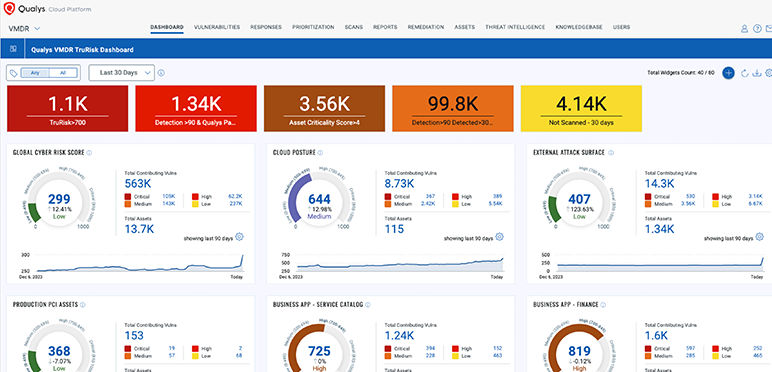
Qualys VMDR (Vulnerability Management, Detection, and Response) is built on the Qualys Enterprise TruRisk™ Platform and combines asset discovery, vulnerability detection, risk-based prioritization, and remediation in a single system. It provides threat intelligence and continuous monitoring to detect critical and zero-day vulnerabilities across on-premises, cloud, container, and mobile environments.
Key features include:
- Asset discovery: Identifies known and unknown assets across on-premises, cloud, internet-facing, container, and mobile environments.
- TruRisk™ prioritization: Applies contextual risk scoring using real-time threat indicators and frameworks such as MITRE ATT&CK®.
- Continuous monitoring: Detects zero-day and critical vulnerabilities faster through cloud agents, passive sensors, and virtual scanners.
- Integrated patch and mitigation workflows: Deploys patches directly or generates ITSM tickets to streamline remediation and reduce MTTR.
- Configuration and compliance assessment: Evaluates systems against CIS benchmarks, PCI DSS requirements, and other compliance standards.
- Unified risk view: Aggregates vulnerability, configuration, certificate, and software risk factors into a centralized platform.

Source: Qualys
7. Cisco Vulnerability Management

Cisco Vulnerability Management (formerly Kenna.VM) is a risk-based vulnerability management platform that uses data science and threat intelligence to prioritize remediation efforts. It aggregates vulnerability and asset data from existing tools and applies predictive analytics to forecast exploit likelihood.
Key features include:
- Risk-based prioritization: Uses advanced algorithms and threat intelligence to recommend fixes that will reduce risk most effectively.
- Exploit prediction: Forecasts vulnerability weaponization with predictive models to enable proactive remediation.
- Threat intelligence: Incorporates 19 threat intelligence feeds to assess evolving risks.
- Unified data aggregation: Pulls vulnerability and asset data from existing scanners and tools to create a single source of truth.
- Intelligent SLA management: Sets remediation timelines based on risk tolerance and tracks performance against goals.
- Clear risk reporting: Generates simplified risk scores and reports to support communication with technical and non-technical stakeholders.

Source: Cisco
Traditional and Hybrid Vulnerability Scanners
8. Tenable Nessus

Tenable Nessus is a vulnerability assessment solution designed to help organizations identify, prioritize, and remediate security weaknesses across IT networks and cloud environments. It provides point-in-time vulnerability scans with broad CVE coverage and a large plugin library that is continuously updated.
Key features include:
- Extensive vulnerability coverage: Assesses over 100,000 vulnerabilities using a large and frequently updated plugin set.
- Risk-based prioritization: Applies vulnerability scoring to help teams focus remediation on the most critical risks
- Pre-built audit policies: Includes templates for configuration, compliance, and security assessments
- Web application scanning: Supports scanning of web applications and internet-facing assets (availability depends on edition
- Flexible deployment: Offers multiple deployment options to suit different environments.
- Configurable reporting: Generates customizable reports to support remediation tracking and compliance needs.

Source: Tenable
9. ManageEngine Vulnerability Manager Plus

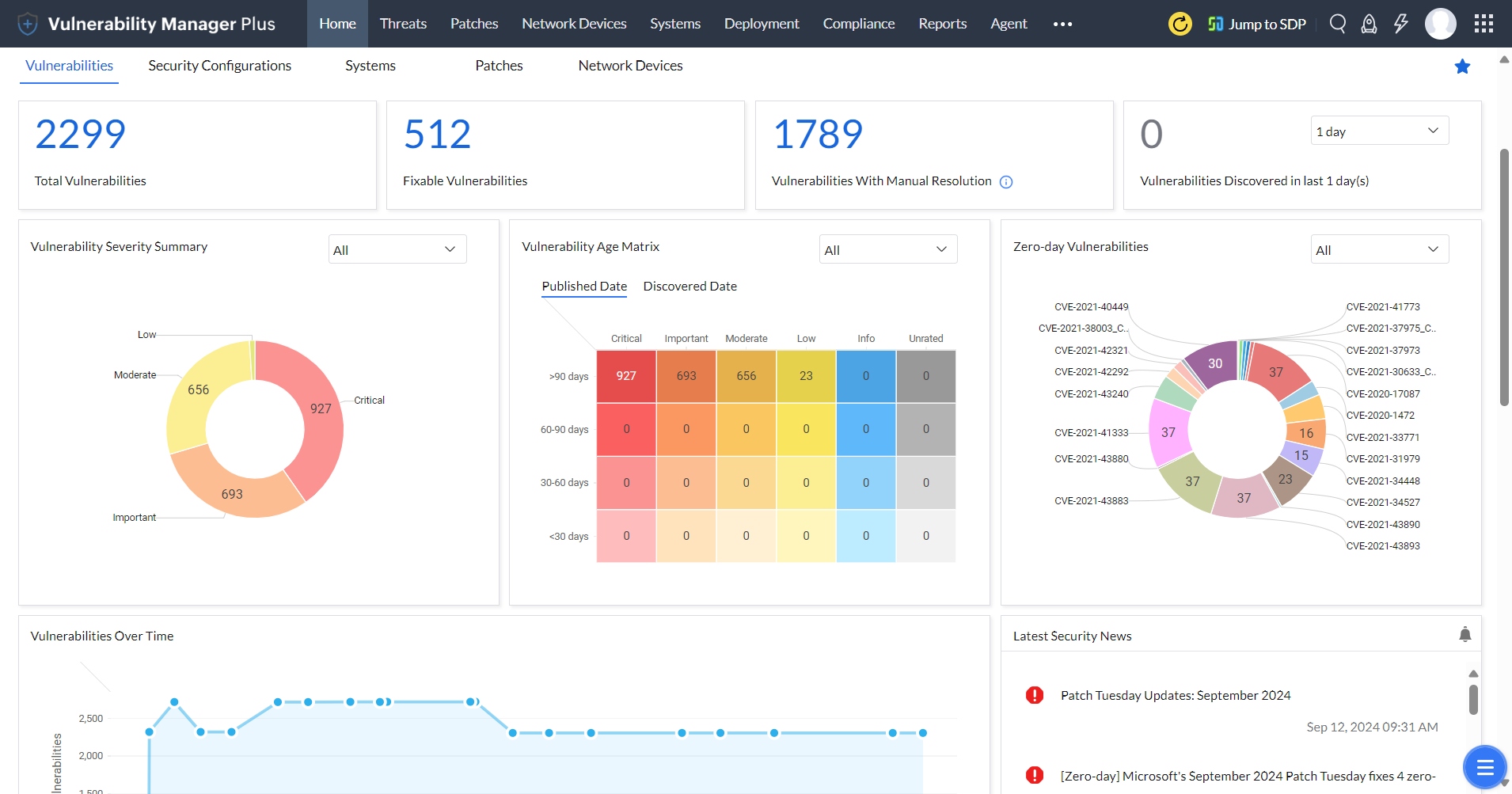
ManageEngine Vulnerability Manager Plus is an enterprise vulnerability management and compliance solution that combines scanning, assessment, and remediation in a single console. It supports Windows, macOS, Linux, and network devices across local, remote, and roaming endpoints.
Key features include:
- Vulnerability assessment and prioritization: Identifies and ranks vulnerabilities based on exploitability, severity, age, affected systems, and fix availability.
- Integrated patch management: Automates patch download, testing, and deployment for operating systems and over 500 third-party applications.
- Security configuration management: Detects and remediates system misconfigurations aligned with CIS and STIG guidelines.
- Compliance auditing: Evaluates systems against more than 75 CIS benchmarks and provides remediation guidance.
- Zero-day mitigation: Deploys pre-tested scripts to reduce exposure while waiting for official patches.
- Web server hardening: Identifies and addresses vulnerabilities in internet-facing servers.


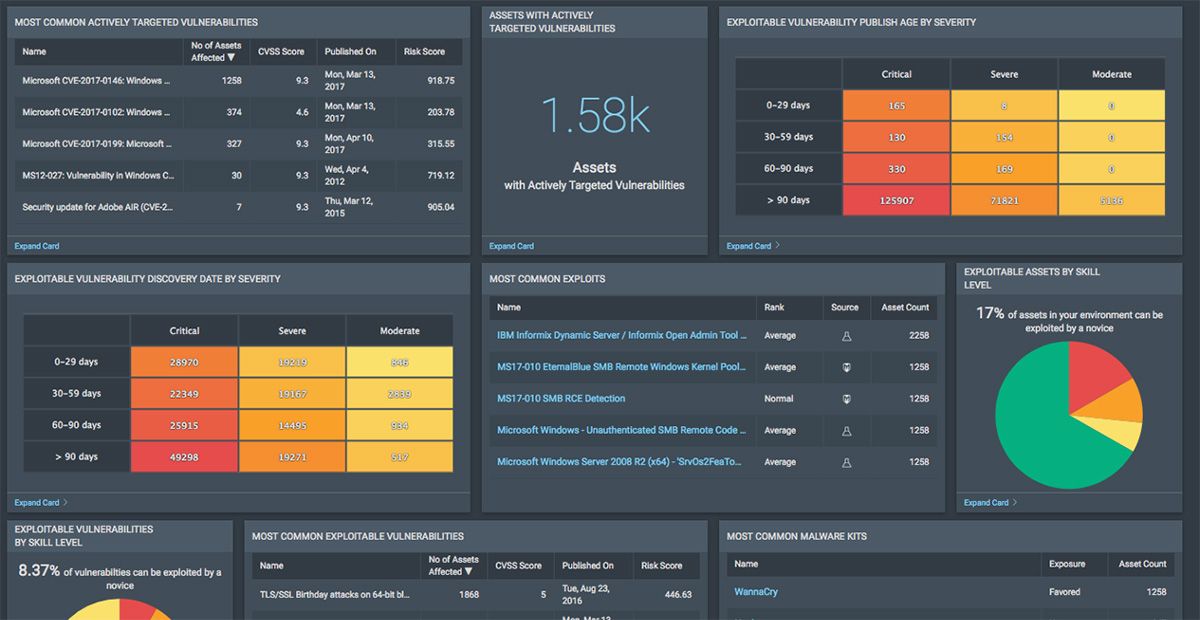


Source: ManageEngine
10. OpenVAS

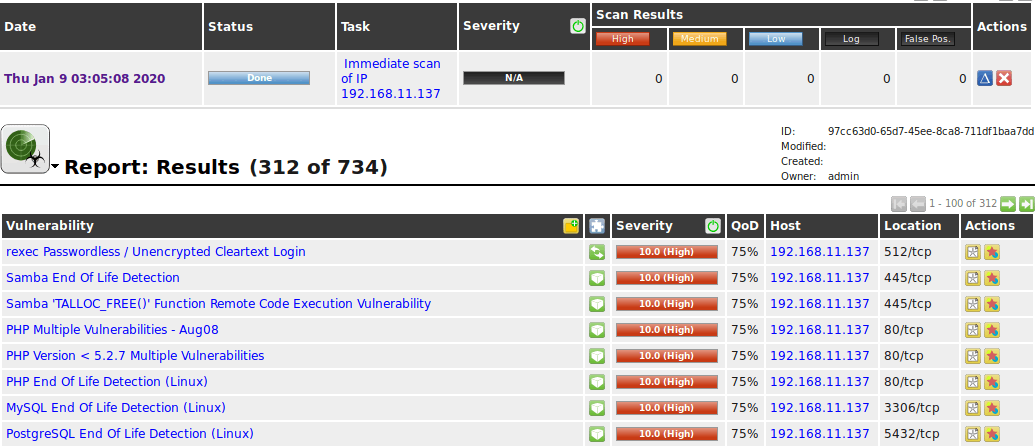
OpenVAS (Open Vulnerability Assessment System) is a full-featured, open-source vulnerability scanner developed by Greenbone. It supports both authenticated and unauthenticated testing across a wide range of internet and industrial protocols. OpenVAS receives vulnerability tests from a long-standing feed that is updated daily.
Key features include:
- Authenticated and unauthenticated scanning: Performs credentialed and non-credentialed tests to assess internal and external exposure.
- Broad protocol support: Scans using high-level internet protocols and low-level industrial protocols.
- Daily updated vulnerability feed: Uses continuously updated test definitions to detect new vulnerabilities.
- Large-scale scan performance tuning: Includes capabilities to optimize and manage scans in large environments.
- Custom vulnerability tests: Provides an internal programming language to create and extend custom scanning checks.
- Open-source foundation: Available as part of the OpenVAS Community Edition with accessible source code.

Source: Greenbone
Conclusion
Vulnerability management is no longer just about scanning and patching; it’s about achieving continuous, comprehensive visibility across the entire IT landscape. As environments become increasingly hybrid and complex, tools that combine application dependency mapping, real-time risk detection, and intelligent prioritization offer a transformative advantage.
By understanding how assets, business applications, and users interact, organizations can proactively identify vulnerabilities, reduce attack surfaces, and minimize risk; all while ensuring operational resilience and regulatory compliance. This application-centric, holistic approach is fast becoming the gold standard in modern cybersecurity programs.